Ad Fraud: $7.4B in Waste From Bad Data and Fake Impressions

Streaming TV advertising is projected to hit $38 billion (U.S.) in 2026 but a growing body of evidence suggests a staggering portion of that money is actually not buying anything.
Two independent analyses, released within days of each other, have arrived at the same conclusion from opposite directions: Truthset, a data intelligence firm, worked top-down from identity signals and audience data accuracy. Dr. Augustine Fou, an independent ad fraud researcher, worked bottom-up from impression-level forensics captured by his FouAnalytics platform. What they found should force a serious reckoning in the open programmatic market.
$7.4 Billion in Waste
Truthset's 2026 State of Data Accuracy Report puts hard numbers on what many in the industry have whispered about for years. With 88% of CTV transactions now flowing through programmatic channels and roughly $18.4 billion moving through open auctions, the accuracy of the underlying identity signals matters enormously.
The foundational method for connecting a streaming ad to a physical home, the IP-address, is only accurate 13% of the time. Truthset found email-to-postal matching accurate only 51% of the time. Age segment accuracy sits at 13%. Gender segments hit 61%. The presence-of-children segment, a targeting parameter advertisers pay a premium for, lands at 41%.
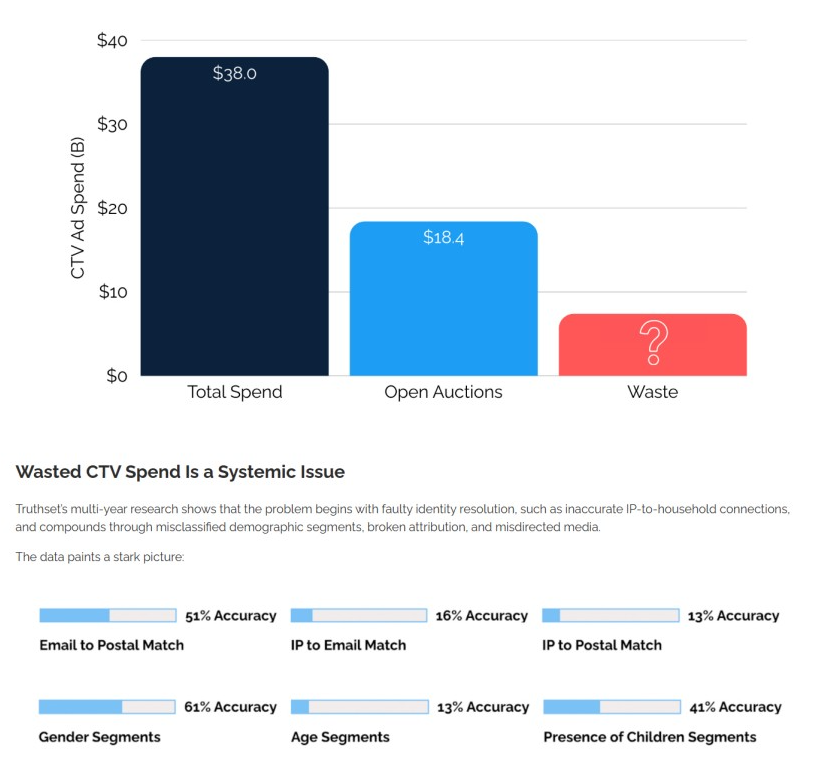
When every signal feeding the targeting engine is this unreliable, the waste compounds at each stage of the supply chain. Truthset's conservative estimate: roughly 40% of every dollar spent spent on streaming ads in the open programmatic market is wasted due to inaccurate data. That translates to a projected $7.4 billion in lost value in 2026 alone.
What the Fraud Actually Looks Like
In multiple campaigns Fou Analytics analyzed, ads purchased as "Connected TV inventory"(CTV - a television connected to the internet) were actually served on websites and in mobile app display slots, likely with the sound-off, likely in a 300x250 ad unit, likely never seen by a human. Completion rates still showed 80-90% because fraudulent actors triggered the completion tracking pixel. The reporting looked clean. The delivery was junk.
The intention of advertising on streaming TV is to land on a large screen connected to a household's cable modem or wifi. B ut according to Fou Analytics, data regularly shows 5-25% of impressions are running on wireless carrier IPs: T-Mobile, Verizon, Cellco. That's not a TV connected to the internet in someone's living room. That's a mobile device on a cell network. In some cases it might be a kid watching Disney+ on an iPad in the backseat. But it doesn't deserve the price tag of living-room attention

In one campaign examined by Dr. Fou, 61% of the streaming ad impressions had 'no detectable source'. No identifiable app, no bundle name, no website. The ads disappeared into a black box. Whether that's fraud, misconfiguration, or something else, the practical result is the same: you paid CTV prices for inventory you can't verify even existed.
Ad Fraud Convergence
What makes these two analyses significant is not just their individual findings but where they intersect.
Truthset says IP-to-household matching is 13% accurate. Fou's forensic data shows why: ads running on wireless carrier networks, impressions routed through data center chains with zero residential IPs, and massive volumes of inventory with no detectable delivery endpoint.
The Uncomfortable Math
That tax falls unevenly. Walled gardens like Amazon and Google sit on authenticated, first-party data that makes their targeting demonstrably more reliable. The open programmatic market, particularly the free ad-supported tier that lacks logged-in users, is left trying to monetize audiences with signals that are wrong nearly nine times out of ten.
Scott McKinney, Truthset's CEO, frames the industry's predicament cleanly - “If marketers can’t rely on the data guiding their decisions, they’re flying blind.”
The $38 billion CTV market isn't shrinking. But the share that actually delivers what advertisers think they're buying might be far smaller than anyone with a media plan wants to admit. The question is no longer whether the waste exists. It's whether the buy side has the stomach to measure it honestly and act on what they find.
By the Numbers
Learn How to Spot Ad Fraud with Dr. Fou here
Get the SOS. Brief
The sharpest streaming intelligence, delivered to your inbox.