Gaming the Front of the Line: A New State of Streaming Contributor Enters the Chat
The National Football League tracks player movement down to the millimeter. Using high-definition cameras and cloud infrastructure, teams build digital twins of athletes to predict injuries before a muscle even strains. In basketball, tracking platforms like Hawk-Eye map 29 specific biometric points on every player simultaneously, while predictive systems like Zone7 forecast muscle strains with a reported 72% accuracy. It is a stunning display of predictive analytics used to protect human potential.
In streaming television advertising, equally sophisticated machine learning models are deployed to track consumer behavior. However, those models get applied to a far less noble cause. Ad systems are designed to claim conversion credit for things that were already going to happen.
The advertising ecosystem has entered its own era of digital twins. Tech and commerce giants like Amazon, Alphabet, Meta, and Walmart have pooled massive, deterministic datasets covering exactly how we live, browse, and buy. Legal scholars note that this corporate aggregation builds asymmetric tracking models designed exclusively for primary platform benefit (Elvy, 2017). They know your next move.
When a demand-side platform combines these profiles with predictive AI, the goal shifts. The system stops trying to convince a consumer to buy a product. Instead, the most effective solution is to leverage the strength of modern AI - LLMs and predict the next action of consumers who are already on the verge of buying.
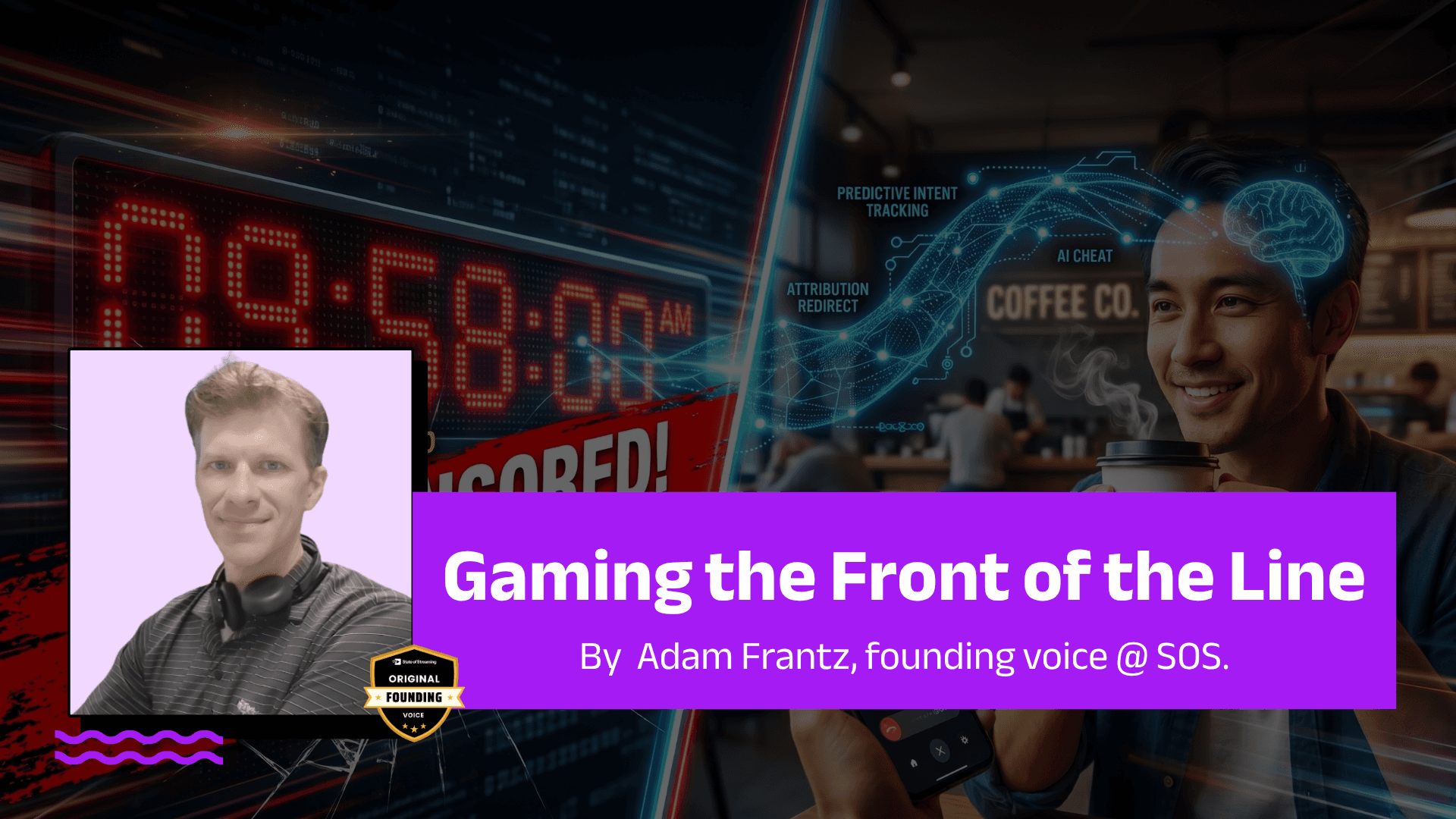
If a model calculates with 94% certainty that you are going to purchase a specific brand of coffee at 10:00 AM on Thursday, the most profitable move for an ad network is not to change your mind. The most profitable move is to place a streaming ad on your screen at 9:58 AM.
This is not marketing. This is an expensive toll booth set up along a path you were already walking.
Current measurement frameworks rely heavily on last-touch attribution. Under this math, that 9:58 AM streaming spot looks like a stroke of genius. The dashboard reports a massive return on ad spend. The agency celebrates. The brand pays the invoice.
The entire exercise is performance theater. The ad did not create a customer. It simply gamed an algorithmic system designed to claim accreditation for an inevitable action.
The defense from the walled gardens is that data pooling creates a more relevant consumer experience. This control creates a deeper friction.
A peer-reviewed framework in Frontiers in Sports and Active Living argues that because performance metrics are inseparable from a worker's identity, individuals should hold true data sovereignty: the legal right to approve, monitor, or revoke access to their behavioral history (Athlete data sovereignty, 2025). Imagine, if individual consumers actually owned their own profile data (possessing that same legal right to approve, monitor, or revoke access to their behavioral history) the current ad tech optimization engine would suffer a panic attack.
The industry rejects true data ownership because it would expose how little incrementality actually exists in hyper-targeted performance channels. “Incrementality” being the measure of sales that would not have happened without the ad exposure. Much of what passes for highly optimized streaming targeting is just a sophisticated game of capturing credit for existing demand rather than generating new demand.
Legal experts examining the commodification of data point out that treating behavioral profiles purely as a corporate asset creates massive market failures, leaving individuals with zero leverage over their digital property (Cofone, 2020; Hazel, 2020). Until that construct changes, consumer tracking will remain an extractive enterprise.
The real heavy lifting is still done early in the consumer journey. High-funnel, less-focused streaming campaigns introduce ideas, build affinity, and shape intent long before a consumer reaches the checkout line. Yet because these broad awareness spots occur ages before the purchase, last-touch, position-based, and even more sophisticated attribution models penalize them. We are actively starving the channels that create demand to feed the algorithms that intercept it.
The data centers powering modern streaming advertising have made media buying more precise than ever. But precision is not the same as persuasion. As long as brands continue to judge campaign success by models that reward proximity over impact, they will keep paying premiums to show ads to people who have already made up their minds.
The uncomfortable truth is that our most advanced AI tools are not discovering new audiences. They are just getting better at finding the front of the line and claiming they built the line of consumers at the checkout counter.
If You Liked This You May Also Like
AI Personalization at Scale: Lessons Media Can Learn from Telecom CX Platforms
Your Ad Stack Was Automated on Both Ends Simultaneously. What Should You Know?
References
Athlete data sovereignty: addressing the legal and policy gaps in sports technology. (2025). Frontiers in Sports and Active Living, 7, 1742484. https://doi.org/10.3389/fspor.2025.1742484
Cofone, I. (2020). Beyond Data Ownership. SSRN Electronic Journal. https://doi.org/10.2139/ssrn.3564480 Cited by: 65
Elvy, S. A. (2017). Paying for Privacy and the Personal Data Economy. Columbia Law Review, 117(6), 1369-1459. https://columbialawreview.org/content/paying-for-privacy-and-the-personal-data-economy/
Hazel, S. (2020). Personal Data as Property. SSRN Electronic Journal. https://doi.org/10.2139/ssrn.3669268 Cited by: 49
Get the SOS. Brief
The sharpest streaming intelligence, delivered to your inbox.