When a Creator Leaves, What Stays? - Attention Capital | A Column by Josh Stein
Editor's Note
Attention Capital is a syndicated column by Josh Stein decoding the economics of media, sports, and platform ecosystems — where attention becomes enterprise value and the contracts behind the cash flow get priced like the credit they actually are. Fixated's acquisition of Studio71 is sparking a new wave of creator rollup hype, but capital is ignoring the structural flaw that caused a decade of MCN write-downs. Creator rosters aren't IP libraries — they are terminable service contracts, and the market must price the collateral problem before the talent walks.
Welcome back to Attention Capital.
A thousand creators just changed hands. Fixated acquired Studio71’s North American business on April 21, giving the combined company a roster of more than 1,000 creators and billions of monthly views. Every trade press headline called it the Avengers assemble moment for the creator economy.
The Avengers are contracted IP. Creators are not.
That distinction is the entire argument of this piece. In Attention, Collateralized, I argued that attention is the next great asset class. In How to Underwrite Attention, I laid out the methodology for pricing it. This piece takes the next step. What happens when capital pays for attention it does not own, from a counterparty who can walk.
A decade of write-downs answered that question the first time. This transaction asks it again.
For the Attention-Constrained
The deal:
Fixated acquired Studio71’s North American business on April 21, 2026, combining more than 1,000 creators and billions of monthly views under one roof. ProSiebenSat.1 kept the German-speaking operations and cleared the U.S. book off its balance sheet.
The frame:
Fixated’s president, Jason Wilhelm, told Forbes the old MCNs and the creator economy are two different businesses. Between 2013 and 2019, four institutional buyers placed large bets on bundled-creator rollups. All four produced write-downs. The words are new. The argument is not.
The collateral thesis:
An MCN roster is not an IP library. Music catalogs are financeable because the underlying asset is statutory. A creator roster is the opposite. The content, the audience, and the contract termination option all belong to the creator. Capital priced the first cycle as if rosters were catalogs. They were not.
The implication:
Fixated has real operational advantages over its predecessors. None of them changes the collateral structure. The next cycle gets priced on whether credit desks ask the question the first cycle skipped: when a creator leaves, what stays?
The News and the Claim
Fixated is a Los Angeles-based operator founded in 2023 by Zach Katz, former president of FaZe Clan, and Jason Wilhelm, who co-founded TalentX. The company took a $10 million investment from Eldridge Industries in 2025 and has been assembling the infrastructure for the creator career ever since. Management. Subscriptions. Talent representation. Now distribution.
Studio71 arrived at Fixated with a particular kind of pedigree. ProSiebenSat.1 founded Studio71 in 2013 and merged it with Los Angeles-based Collective Digital Studio in 2015 at a post-money valuation north of $240 million. For a German strategic that still calls itself a media company, parting with the American creator engine amounted to a balance-sheet cleanup.
The deal arrived with a prepared frame. Fixated’s president treated the comparison with the last MCN cycle as a category error. In an interview with Forbes, Wilhelm said the old multi-channel networks and the creator economy are two different businesses, and that the problem Studio71 was built to solve, YouTube monetization, was solved a long time ago. The new thing, he argued, is making creators into full media companies.
The quote deserves to be read in full:
"MCNs and the creator economy are two different businesses. Studio71 was built to solve a specific problem—helping creators make money on YouTube when that was basically the whole game. That problem got solved a long time ago. What hasn’t been solved is the next thing: how a creator actually becomes a full media company. IP, distribution, real leverage, across every platform."
Read it once without the context. Read it again with it. The argument is that the first MCN cycle failed because it was narrow, and Fixated will succeed because it is wide.
Run that sentence against the last cycle, and it stops looking fresh. Disney said the same thing when it relaunched Maker Studios as Disney Digital Network in 2017. Otter Media said it when it built Fullscreen into a global media company under AT&T. DreamWorks said it when it pitched Awesomeness as a full-stack creator studio to Verizon and Hearst. Three rebrands, three capital stacks, three write-downs.
This is the claim I want to interrogate. Not to dunk on Wilhelm, who is a capable operator building a serious company. The claim deserves interrogation because capital is about to underwrite it. Large checks are going to move against this thesis. Somebody on the other side of those checks needs a cleaner read on what stays when the creator leaves.
The Graveyard
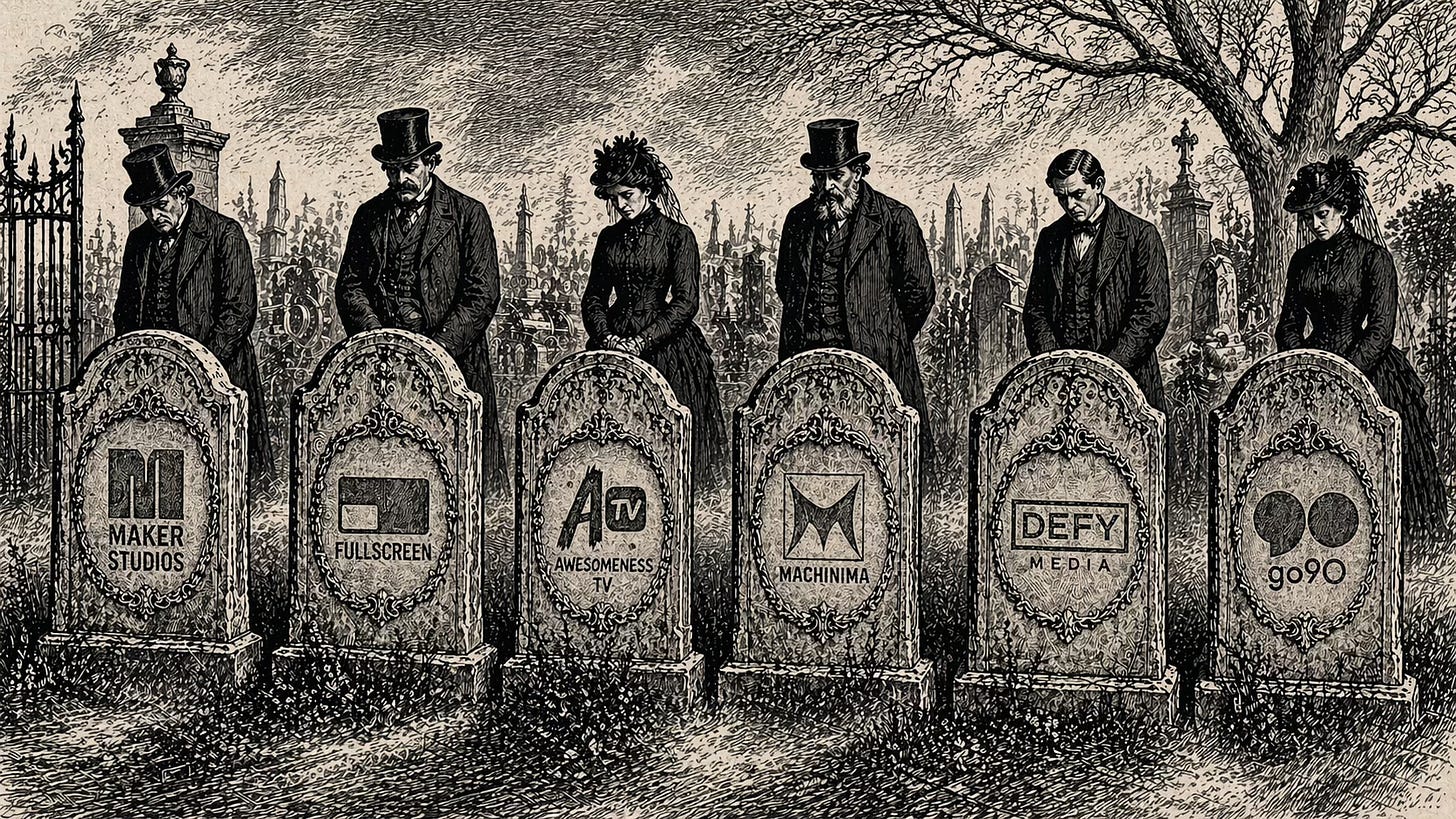
Between 2013 and 2019, four institutional buyers placed large bets on the MCN model. Each bet made internal sense. Each bet produced a write-down.
Disney bought Maker Studios in 2014 for $500 million up front, with earnouts that could have pushed the deal to $950 million. At announcement, Maker had the largest creator roster on YouTube and a thesis that digital-native programming was the next generation of Disney content. Five years later, Disney had cut 80 jobs at Maker, absorbed the shell into a new Disney Digital Network, and effectively wound down the business. Digiday’s retrospective put Disney’s actual cost at $675 million. The balance of the earnout never triggered. Maker’s roster collapsed from tens of thousands of creators to a few hundred.
AT&T and Chernin’s Otter Media joint venture acquired a majority stake in Fullscreen in 2014. Otter Media positioned Fullscreen as the next-generation global media company, complete with branded studios, talent management, and a subscription video service. The SVOD launched in April 2016. AT&T shut it down in January 2018, resulting in layoffs. By December 2018, Otter Media had reorganized Fullscreen, Machinima, and Rooster Teeth into a consolidated structure with headcount cuts across the portfolio. Fullscreen had operated for seven years.
AwesomenessTV took the most spectacular valuation arc. DreamWorks Animation bought it in 2013 for $33 million up front with up to $117 million in earnouts. Hearst took a 25% stake, valued at $81.25 million, in 2014. Verizon paid $159 million for a 24.5% stake in 2016, implying a roughly $650 million valuation at the peak. Viacom bought the whole business for around $25 million in 2018. The capital stack lost approximately 96 cents on the dollar in less than 60 months.
Warner Bros. bought Machinima in 2016 with a reported value slightly under $100 million, according to Variety’s sources. WarnerMedia laid off the remaining 81 employees in February 2019 and shut the operation. Three years from acquisition to shutdown.
The corridor between 2018 and 2019 produced other losses worth remembering. Defy Media, which housed Smosh and Clevver, collapsed in November 2018, leaving its creators stranded. Verizon took a $658 million charge against go90, the mobile-first video service built largely on MCN-adjacent inventory, and killed the product. Each of these had an infrastructure argument attached. Each of those arguments failed to convert infrastructure into ownership.
Maker. Fullscreen. AwesomenessTV. Machinima. Defy. go90. Every one of them ran a bundled-creator thesis. Every one of them reached institutional scale. Every one of them produced a write-down.
One failure is a mistake. Six is a cycle.
Bad operators did not drive the cycle, and neither did unlucky timing. A shared structural misread drove it. The assets each buyer believed it was purchasing did not actually reside within the entity. Those assets sat across the table, renewable at expiration.
There is one more feature of that period worth naming. Every buyer had seen the previous buyer’s results before placing the next bet. DreamWorks bought Awesomeness in 2013, and the ink was barely dry when Disney bought Maker in 2014. Otter Media acquired Fullscreen the same year. Hearst and Verizon doubled down on Awesomeness in 2014 and 2016, with Maker’s trajectory already in the public record. Warner Bros. bought Machinima in late 2016, months after Disney started cutting Maker’s headcount. The pattern was visible in real time. Each buyer believed their version would be different because their integration story was better. Each buyer’s integration story turned out not to matter.
A Bigger Pool, The Same Hole
The first MCN cycle ran against an audience that was still mostly watching broadcast television. The second cycle is running against an audience that has already moved.
Nielsen’s May 2025 Gauge put streaming at 44.8% of U.S. TV watch time, broadcast at 20.1%, and cable at 24.1%. Streaming beat broadcast plus cable for the first time on record. YouTube alone captured 12.5% of total TV viewing time that month. YouTube is bigger than any single streaming service and bigger than every cable network except the largest. The thing inside YouTube is creators.
PwC’s 2025 Global Entertainment and Media Outlook projects global entertainment and media revenue to reach $3.5 trillion by 2029, with digital advertising rising from 72% to 80% of total ad spend over the forecast window. The fastest-growing slice inside that pool is creator-adjacent inventory and direct-to-fan monetization.
The prize is considerably larger than the prize the first cycle was fighting over. The structural question of who owns the asset that produces the cash flow is identical.
A bigger pool does not change the collateral question. It makes the collateral question more expensive. If the first cycle wrote down a few billion dollars across half a dozen bets, the next cycle has the room to write down an order of magnitude more if it makes the same mistake at the scale the new audience supports.
The counterpoint is that every audience migration creates a one-time repricing of the aggregator layer on top of it. Cable repriced broadcast. Streaming repriced cable. Creator platforms are repricing streaming. The aggregator that gets it right during the repricing wins permanently. The aggregators that got it wrong during previous repricings wrote down. The question is whether the second MCN cycle is repricing the aggregator role or repeating its mistakes at a larger scale.
The Rebrand That Always Rhymes
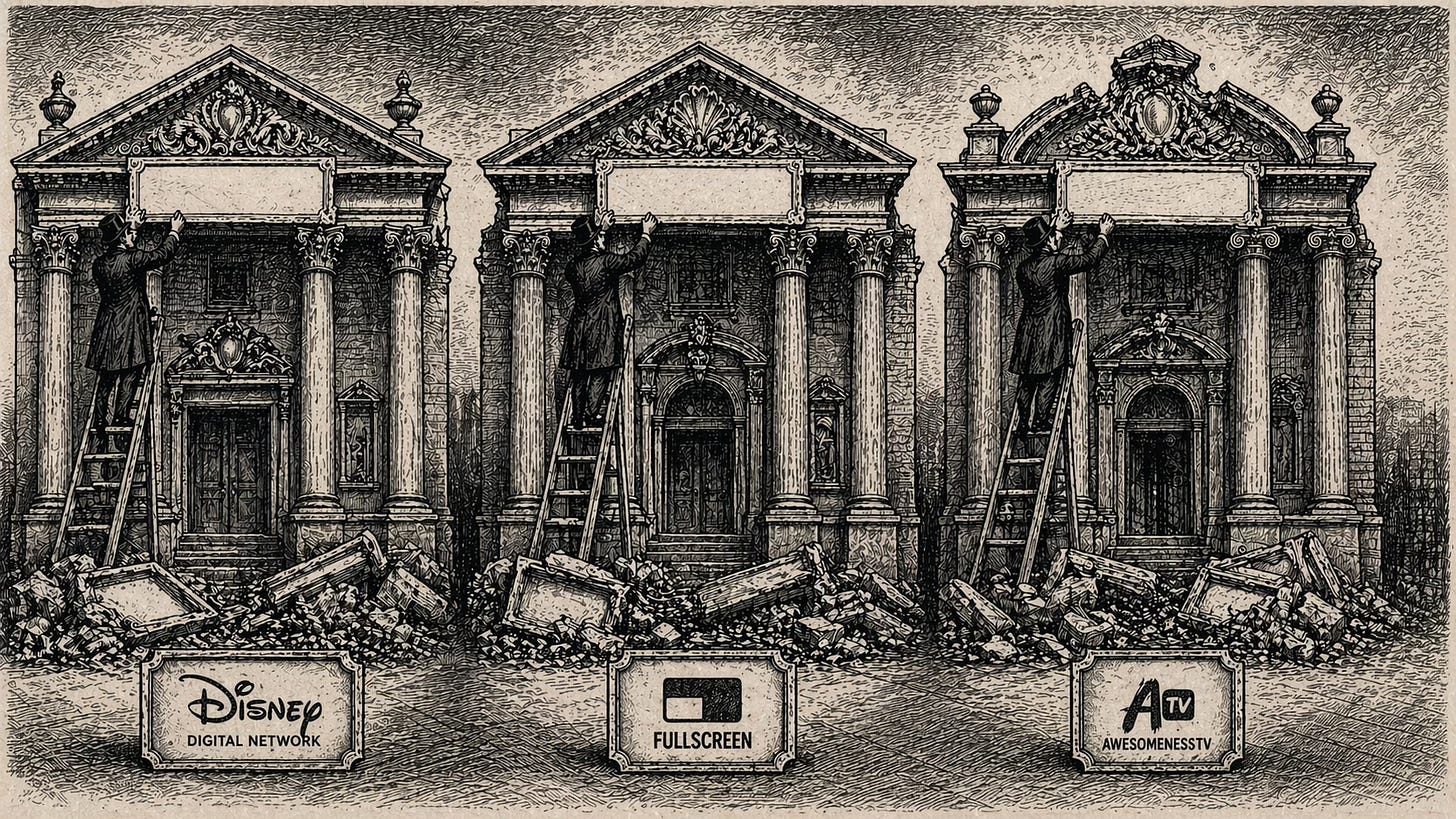
Wilhelm’s claim is that the old MCNs were narrow, and Fixated is building something wider.
Wilhelm’s framing is a legitimate operational distinction. The creator-to-full-media-company transition is a real problem; it is not the problem Studio71 was built to solve, and an integrated stack designed around it is materially different from a YouTube monetization vendor. The question is not whether that distinction is valid at the operator level. The question is whether an integrated stack built on top of terminable creator contracts produces a different collateral structure than a narrower stack built on top of the same contracts. That is a structural question, not an operator question, and the precedent record speaks to it.
Wider was tried. Three times. At scale. With serious capital.
Disney rebranded Maker Studios as Disney Digital Network in May 2017. The pitch was end-to-end: Disney-owned creators, an originals slate, branded-content sales, talent development, and a direct connection into Disney’s theatrical and television businesses. If infrastructure was the solution, Disney had more of it than anyone. Two years later, the unit was gone.
Fullscreen launched its subscription video service in April 2016 at $4.99 per month. Fullscreen had Otter Media behind it. Otter Media had AT&T behind it. AT&T acquired Time Warner in June 2018. A vertically integrated carrier, a premium content parent, and a talent-rich MCN were supposed to finally solve the creator-to-media-company transition. Nine months after the Time Warner close, the SVOD was shut down.
AwesomenessTV went the widest. A film division, Awesomeness Films, produced multiple theatrical and streaming titles. A YA publishing imprint, Awesomeness Ink. A talent agency. A production arm. A branded-content studio. By 2016, it was selling subscription bundles to Verizon Go90. The corporate parent wrote the equity down to zero.
Read Wilhelm’s quote again against that precedent stack. Three companies with theatrical arms, television arms, sales forces, platform relationships, and treasury departments said the same thing he is saying. All three produced the same outcome.
The pitch is not new. The outcome pattern is the argument.
That leaves one variable worth pricing. The thing that sat under every MCN rebrand and broke each of them in turn. The collateral problem.
The Collateral Problem Nobody Priced
A credit analyst reading the MCN rollup thesis in 2014 would have seen three revenue lines. AdSense share from YouTube. Branded-content fees. Talent management. Underwriting each of those lines requires one question: who controls the asset that produces the cash flow?
The AdSense share sits on top of the creator's owned content. The YouTube Partner Program splits revenue with the channel owner, not the network. The MCN’s right to that revenue exists only because a contract says so, and only for as long as that contract is in force.
The branded-content fees route through the creator’s audience. No audience, no brand deal. The creator’s audience is not the network’s audience. The creator can take it to any competing network or manage it directly. YouTube’s own MCN guidance makes this explicit: the channel belongs to the channel owner.
Talent management revenue is a commission stream on an individual. Individuals change representation. The stream ends when they do.
Every revenue line in the MCN model sits atop an asset the network does not own. The network owns the right to monetize those assets while the creator stays. When the creator leaves, the monetization rights terminate, and the network's roster shrinks.
In credit language, the MCN is a lender with no collateral. The covenant is the creator’s continued presence. The covenant defaults the day the creator walks.
Nintendo owns gravity. Disney owns IP. Netflix owns the retention machine. In The Value of Wonder, I argued that Nintendo’s enterprise value lies in the fact that nobody else can make a Mario. No counterparty can take the asset elsewhere. No contract can expire and strip the vault. That is what a media asset looks like when it compounds.
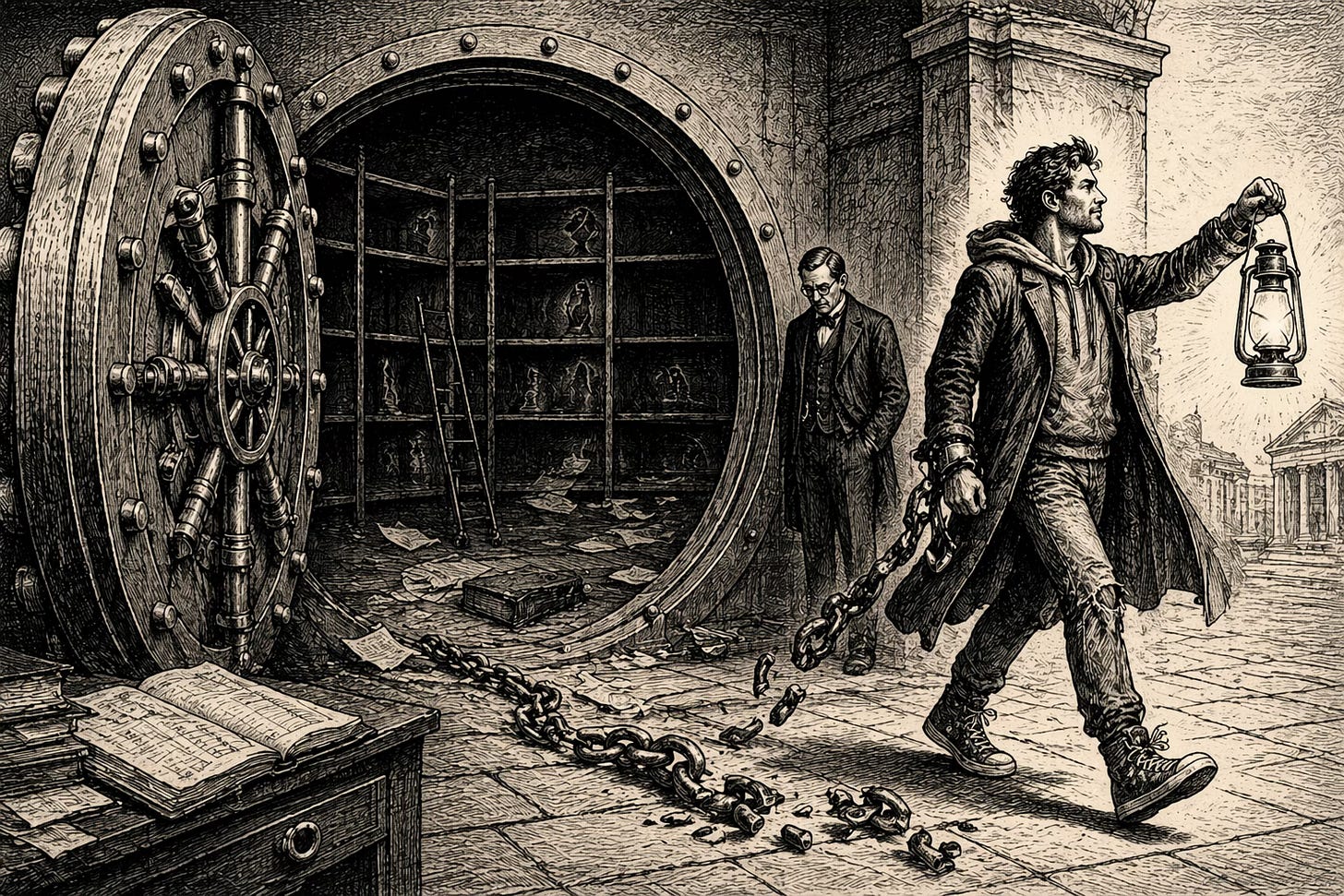
An MCN does not compound. It decays. Because the asset walks.
Fixated’s Wilhelm framing seeks to address this by expanding the relationship's surface area. Manage the creator’s career. Build their subscription business. Represent them for brand deals. Distribute their content. One building, every stage of the funnel.
Surface area does not change collateral structure. It changes service coverage. Service coverage is operationally valuable. It is not a balance sheet line.
AQS exists to separate the two. A creator’s Attention Quality Score assigns weight to durability, owned-audience share, platform independence, behavioral repeatability, and the commercial translation mechanics that turn attention into cash. Those factors price the creator. They do not price the network holding the creator’s contract.
Applying AQS to an MCN portfolio immediately surfaces the problem. The bundle does not have its own score. The bundle has a weighted average of its members’ scores, adjusted for concentration and contract tenor. When the top-scoring members leave, the weighted average tends to collapse toward the median. The bundle’s notional asset value is almost entirely a function of which specific creators are under contract on any given measurement date.
A bundle of durable assets behaves like a bundle of durable assets. A bundle of terminable contracts behaves like a reinsurance book with no underwriting discipline. The first produces a smooth yield curve. The second produces a jagged one. Capital markets will pay for the first and should underprice the second. The first MCN cycle got priced as if it were the first kind of bundle. It was the second.
The Cash Flow Was Always Broken
A generous reading of the first MCN cycle is that the business models were fine, and the buyers simply executed poorly. A structural reading is that the cash flow projections never made sense.
Three lines of the model broke at entry.
Take rates were never going to hold.
When Disney bought Maker in 2014, Maker was taking roughly 30-40% of AdSense revenue on many creator channels. That number is not a stable equilibrium. As creators matured, they renegotiated. As rival networks courted top talent, splits narrowed. By 2017, the industry standard on top creators had collapsed. Networks that paid $500 million for scale inherited a take rate that was actively compressing.
Talent costs were never going to fall.
The initial thesis treated creators as variable costs. More creators equals more revenue equals more margin. What the first cycle demonstrated is that the top of the roster, the creators actually producing the revenue, priced themselves like talent. Guarantees. Signing bonuses. Equity in spinoff ventures. Exit options. By the end of the cycle, the economics on a star creator looked closer to an athlete’s contract than to a publishing relationship.
The exit option was always going to be exercised.
Every contract had an end date. Every end date was a negotiation. Every negotiation was a chance for the creator to compare the MCN’s offering to direct YouTube, a rival network, and going solo with a small internal team. The economics favored walking.
The exit option was not theoretical. Named creators exercised it within named MCNs, as the market observed in real time.
PewDiePie, then the largest creator on YouTube, was a Maker Studios partner when Disney bought the company in 2014. In February 2017, Disney and YouTube both severed ties with him following a series of controversies in The Wall Street Journal. His channel kept growing. Maker’s most valuable roster asset had walked, and the walking itself did not impair the creator’s audience or earnings. It only impaired Maker’s ability to participate in them. That sequence was the cleanest possible demonstration of what an MCN actually owned. It owned an option on the creator, not a stake in the creator.
Smosh, housed at Defy Media, went through a similar arc in 2018. Defy collapsed in November of that year. Mythical Entertainment eventually acquired the Smosh brand, audience, and creative team, and the operation continued. Defy’s creditors were left seeking value in a shell whose productive assets had been transferred to a competitor. The audience never paused.
Cash flow forecasting under those three conditions should have produced a present value lower than the purchase price in every case. The forecasts did not. The forecasts treated the roster as if it were a catalog of music royalties, durable assets with known decay curves. A catalog has a copyright. A copyright cannot walk. An MCN roster is neither.
Music catalogs, as I discussed in Attention, Collateralized, are financeable because the underlying asset is statutory. You own the publishing rights. You own the master. The stream pays you whether the artist is dead, retired, or suing you. Bowie Bonds worked because David Bowie could not unwrite Hunky Dory.
An MCN’s creator roster is the opposite. The content is owned by someone else. The audience is loyal to someone else. The right to monetize expires on a defined date. The present value of a portfolio like that is significantly lower than that of a music catalog with similar headline revenue. Nobody modeled it that way.
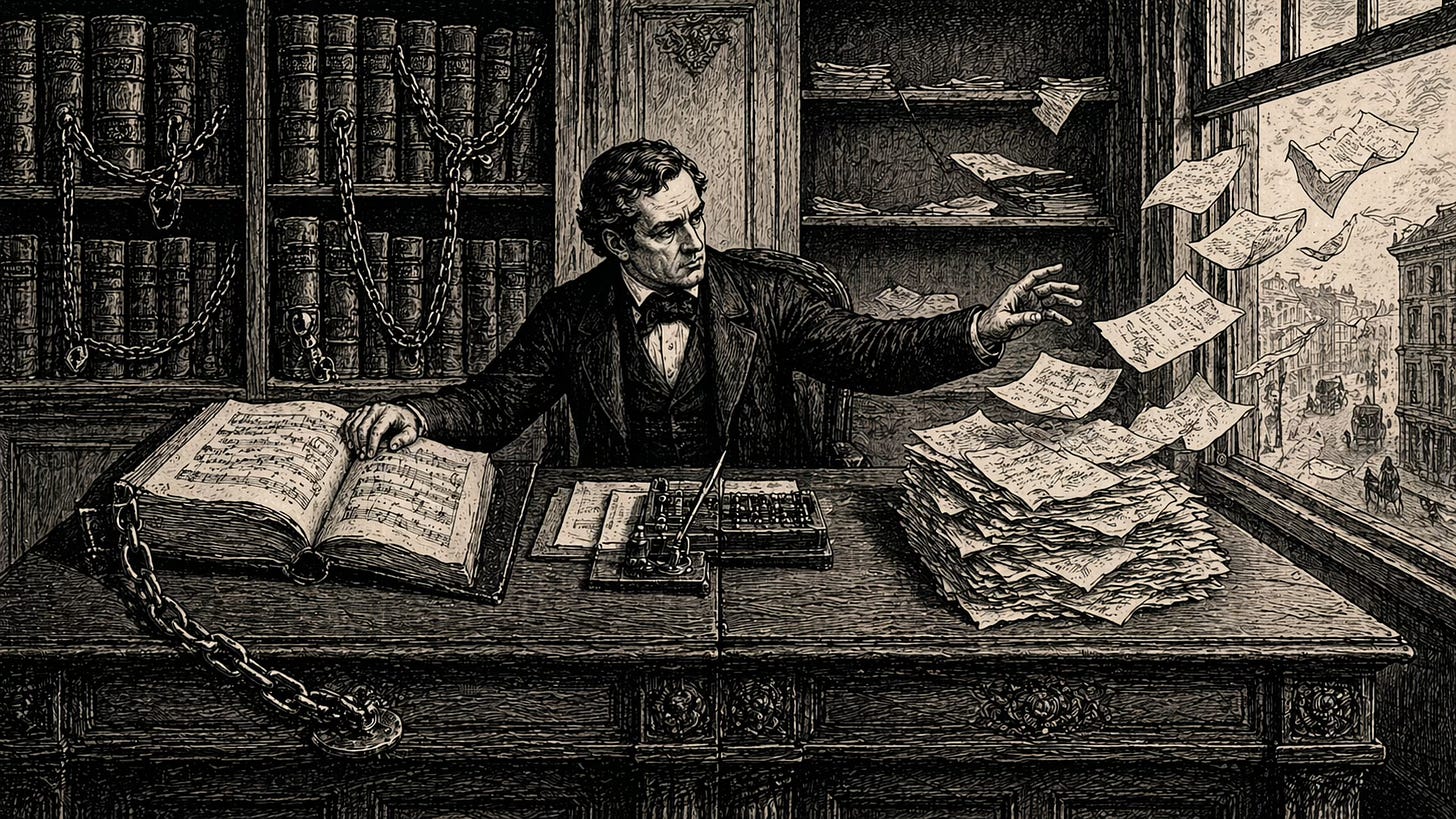
Music catalogs are statutory. MCN rosters are terminable. Capital priced them as if they were the same.
What Changed, What Didn’t
Fixated is not Maker. The team is operationally sharper than Disney’s digital unit was in 2014. The culture is creator-native in a way DreamWorks and NBCUniversal never were. The capital stack, led by Eldridge Industries, is supported by patient investors rather than a strategic acquirer focused on aligning with a theatrical slate.
Katz and Wilhelm are former TalentX and FaZe Clan executives. They grew up inside the creator model. The first MCN cycle was run by film and television executives who treated creators as variable inputs to a familiar product line. Fixated’s leadership treats creators as the product.
The service surface is meaningfully broader than that of any single-function creator business. Management, subscriptions, talent representation, content production, distribution, and now the Studio71 ad-sales infrastructure, under one roof. The specific Studio71 assets folding into Fixated, the mature ad-sales operation, and the book of brand relationships built across a decade of premium creator work, are genuinely differentiated operational infrastructure at a level of maturity no previous MCN has brought to a combination at this stage.
Platform neutrality is a real structural improvement. The first MCNs lived on YouTube and answered to a single platform’s monetization rules. Fixated is positioned for a multi-platform world, where a creator's revenue stacks across YouTube, TikTok, Instagram, Snap, podcast networks, and direct subscription products. Diversification reduces platform risk. It also reduces the bargaining position of the network that services the platform stack, because a creator whose revenue is spread across six platforms does not need a single large agent on the other side.
Studio71 brought specific assets worth naming. Ad-sales infrastructure. Long-standing brand relationships. A podcast network with its own production pipeline. A content studio with credits on mainstream titles. A data and insights layer built across years of operating a premium creator book. These are not trivial. A credit analyst should mark them as real.
They are also largely service infrastructure. Things Fixated can use to keep creators and deliver revenue. They are not owned attention. They do not become more valuable when a specific creator leaves. They become less valuable the day the roster shrinks.
The collateral structure did not change. Fixated does not own the content. Fixated does not own the audience. Fixated does not have the option to terminate the contract. The creator holds it. Every revenue line in the model runs against an asset that can be taken elsewhere.
This inventory is not a prediction. Fixated may run a better MCN than anyone has run before. That is a different statement than saying it has solved the problem that killed the previous cohort. The problem that killed the previous cohort was collateral. The collateral problem is unchanged.
The Underwriting Question
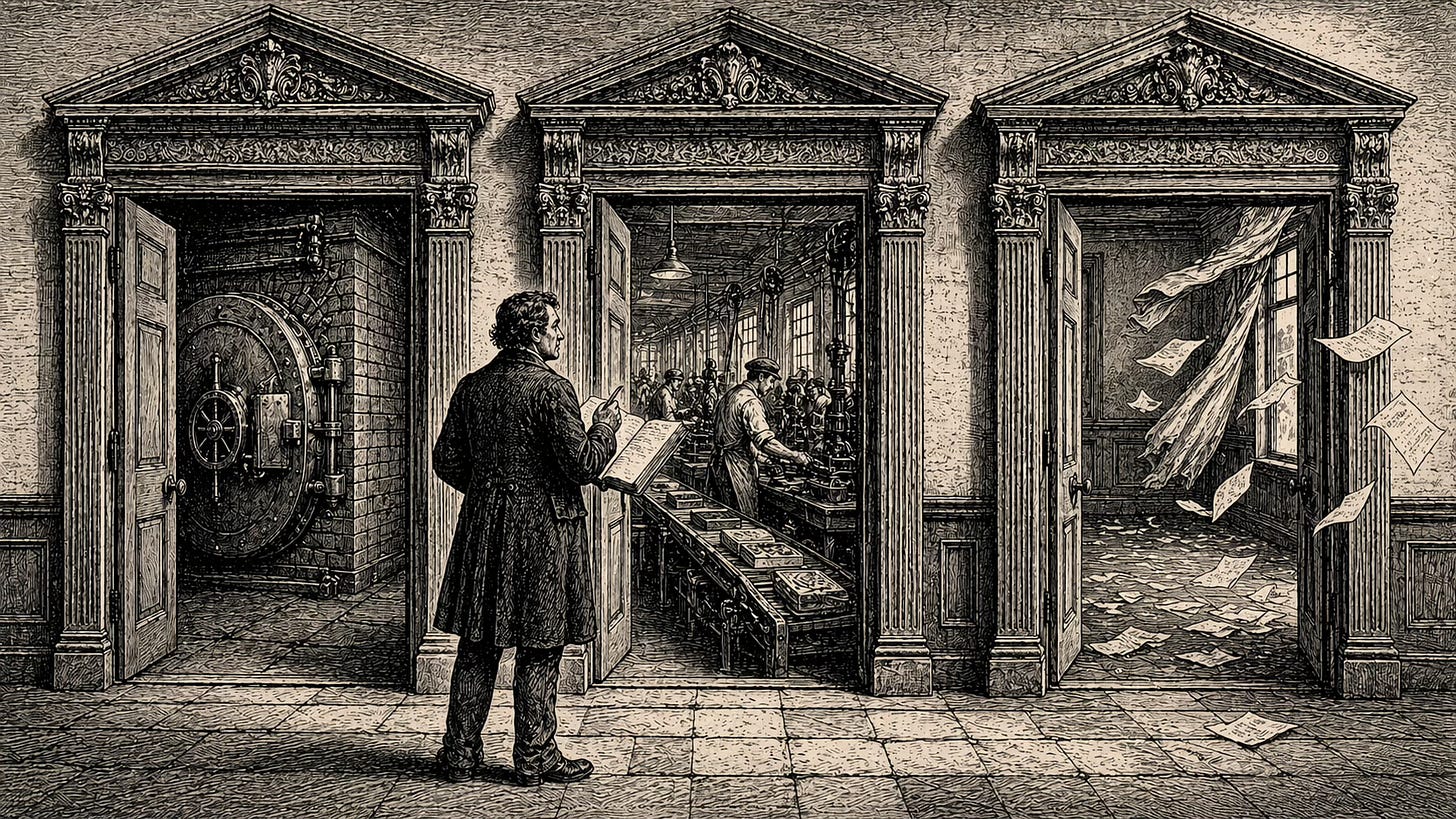
The question capital needs to answer before it funds the next wave is not whether Fixated can build a better creator services firm. That question has an obvious answer, given the team. The question is whether the creator services firm accumulates anything that persists when the creator list turns over.
Put another way, the question is this:
When a creator leaves, what stays?
There are three honest answers. Each describes a different business.
Answer one: the brand stays.
Fixated itself becomes a trust mark. Creators want to sign there because it signals professionalism. Advertisers want to buy there because it signals quality and scale. Even after turnover, the replacement creators fill the slots, and the brand’s value to both sides persists. This is the WME model applied to the creator economy. It is financeable. It requires decades to build.
Answer two: the next creator stays.
Fixated runs a factory. It identifies emerging creators, invests in their development, takes a piece of the upside, and continuously refills the top of the funnel faster than it empties. This is the Hipgnosis-for-creators model, sort of. It requires a specific kind of A&R engine that most businesses cannot build. Hollywood Sunshine and Dick Clark Productions run versions of this for specific verticals. It is financeable, but the underwriting is complicated and depends heavily on the scouting and development function.
Answer three: nothing stays.
When the marquee creator walks, the roster’s earning power collapses with them. The aggregation relationship was always the entire asset. The business is a management contract with a brand name. That business exists. It can be cash-generative. It is not financeable under a credit facility because the collateral evaporates at the named counterparty’s discretion.
Capital underwrote every one of Fixated’s predecessors to answer one. None of them got there. The pattern suggests the default outcome is answer three unless the operator has built explicit, durable mechanisms for answer two.
Aggregation rents a position. Infrastructure owns one.
For a credit desk pricing a facility against a business like Fixated post-Studio71, the underwriting work is specific. What percentage of revenue comes from the top 10 creators, and what are the contract end dates? What are the renewal incentives, and how have they performed historically? What is the average creator tenure, and what happens to revenue when the average tenure rolls off? What is the replacement funnel, and how long does a net new creator take to reach the revenue contribution of the one that left? What are the retention tools that are genuinely proprietary to Fixated, versus retention tools that any competitor could stand up?
Those questions do not assume the answer is bad. They assume the answer is unknown. For a deal of the size being contemplated here, the answer has to be known.
A sensible term sheet against a business like this would price the collateral problem directly. Advance rates calibrated to top-creator concentration, not aggregate revenue. Covenants that step down on a defined threshold of creator departures in any trailing 12-month window. A lockbox on branded-content receivables so the lender controls the collection flow rather than relying on the borrower’s payables discipline. Reserved capacity for the replacement funnel, since the only way the roster holds is if the factory works. Pricing that reflects the fact that this is a service contract book, not an IP library, and that service contract books are a real business, but not an Aaa credit.
None of that is hostile underwriting. It is the underwriting that would have saved a decade of write-downs the last time. A credit desk that treated Maker Studios as an IP library in 2014 made a structural mistake. If we treat a Fixated facility the same way in 2026, we'll be making the same mistake at a price point the new audience supports. The point of learning from a cycle is not to refuse to lend. The point is to lend against what is actually there.
The Lingering Questions
A decade of write-downs sits on one side of the table. A new operator with a deeper stack sits on the other. The room between them is where capital lives or dies.
If Fixated exits the pattern, it will be because the company has built something that the first cycle did not. Not a wider service surface, which the first cycle also built. Not a better operator DNA, which is real but does not change collateral structure. Something that specifically addresses the collateral problem. A brand strong enough to survive roster turnover. A factory fast enough to replace exits before they impact the P&L. A platform product that belongs to Fixated and the creator simultaneously.
None of those is impossible. All of them take years to prove, and none of them have been proven yet.
What would Moody’s do with the Studio71 book if it had to rate it tomorrow? Who holds the risk when a creator paid a seven-figure guarantee walks in year two of a five-year deal? What is the AQS on a thousand-creator bundle, and how does it compare to the AQS on any single top-decile creator inside that bundle? If the answer is that the bundle is worth less than the sum of its parts, what has the infrastructure actually added?
At some point in the next 24 months, an institutional lender will receive a pitch that mirrors the ones Fullscreen, Maker, Awesomeness, and Machinima received between 2013 and 2016. The pitch will be sharper. The operators will be better. The market data will be more favorable. The creators inside the bundle will be more mature. Every one of those improvements is real.
None of them answers the collateral question.
The next cycle gets priced on the answer to that question. The first cycle got priced on the assumption that the question did not need to be asked.
Why Subscribe
Because a new cycle of creator rollups is about to make a billion-dollar underwriting mistake, pricing terminable talent contracts as if they were permanent IP catalogs.
Every week, Attention Capital tracks how documented audience behavior becomes enterprise value: the contracts, the balance sheets built on them, and the layer underneath that finance has not learned to read. If you allocate capital, this is where you learn to price the collateral problem before a star creator’s departure craters your facility. If you operate in media, this is where the difference between renting a roster and owning durable infrastructure gets exposed. If you build audiences, this is the market discovering the true leverage of your exit option.
Get the SOS. Brief
The sharpest streaming intelligence, delivered to your inbox.