The Intelligent Rebundling: Cloud, AI, and the Two Faces of Streaming
Streaming has quietly changed jobs. It began simply as a way to deliver video over the internet. Today, it is becoming something larger: an AI-driven digital platform that must carry live events, personalization, advertising, customer service and now autonomous software, all at once, on an enormous scale. The technology behind that shift is broadly the same everywhere. What differs, market to market, is the set of constraints and priorities wrapped around it. Nowhere is that clearer than in a side-by-side look at the United States and the United Kingdom.
Same technology, different priorities
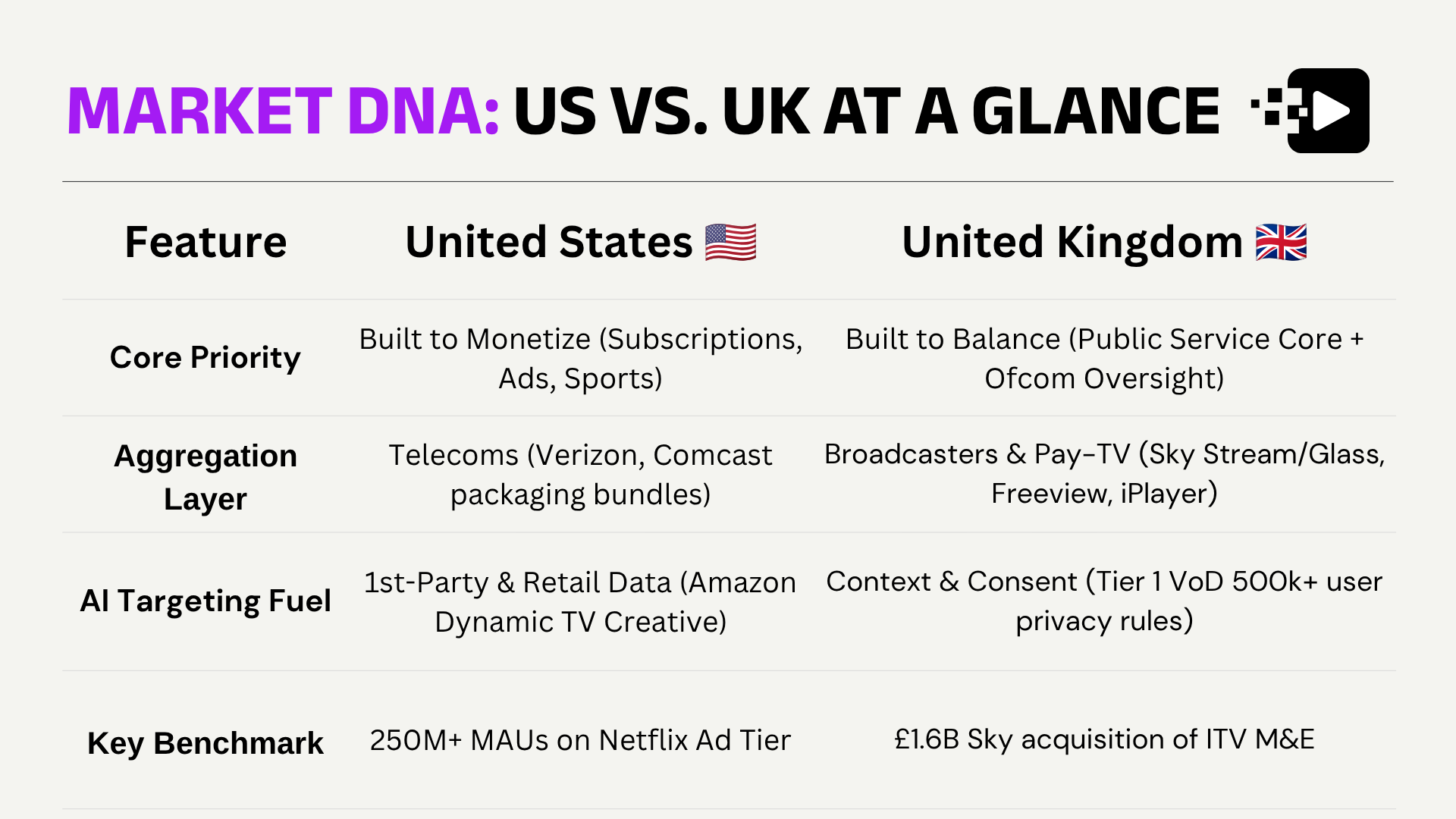
Start with the structural difference, because it shapes everything else. The US streaming market is built to monetize. Scale, subscriptions, advertising and premium sports are the engine, and telecom operators increasingly act as the aggregation layer that ties it together. The central question an American executive asks is how to turn attention into revenue. The UK runs the same commercial engine, but it sits on top of a strong public-service core: the BBC, ITV and Channel 4, with the BBC funded by a license fee rather than advertising. The British question is subtly different: how to monetize while protecting public value and trust.
Regulation is not an afterthought there. It is a design input. The 2026 rollout of the Media Act's video-on-demand rules brought large streamers under Ofcom oversight, and Ofcom's own 2026 Media Nations report captured the moment neatly, showing Netflix edging past the BBC as UK viewers' first choice destination for the first time. The commercial model is now pressing directly on the public-service one.
The cloud is the foundation.
Underneath both markets sits the same foundation: the cloud. The simplest way to explain why it matters is that streaming no longer rewards owning infrastructure. It rewards renting it precisely when you need it. Netflix can launch in a new country without building broadcast facilities there because it runs on public clouds and designs for the spike, a major sports night rather than a quiet Tuesday.
What is striking in 2025 and 2026 is that the traditional broadcasters are making the same move. The BBC now runs iPlayer production workflows on AWS and continues to strengthen its cloud capability. Sky delivers television through Sky Stream and Sky Glass over broadband, with no satellite dish at all. The difference is again one of guardrails. In the US you optimize scale and cost. In the UK you optimize for scale inside consent and data-residency rules. Same cloud, heavier constraints.
AI is one loop, not two choices
Then comes AI, and here the common misconception is that companies must choose between using it to improve the viewer’s experience and using it to make money. In practice these are one loop. Better recommendations keep people watching, and a deeper understanding of the viewer makes advertising more valuable, which funds more content, which improves the experience again.
What differs is where each market points the AI first. The US points it at the advertisement. Netflix built its recommendation intelligence over years and is now using that same viewer understanding to power an advertising business whose ad-supported tier has passed 250 million monthly active viewers, complete with generative and interactive ad formats. The UK points its AI more at the workflow and at discovery. ITV has spoken openly about running 250 live generative-AI use cases and targeting advertising through its own Planet V platform, on data it owns and controls. The BBC, with no advertising model, aims its AI entirely at discovery and public value. The behind-the-scenes AI, the automatic metadata, the compliance checks, the demand prediction before a big match, is common ground on both sides of the Atlantic.
Who owns the bundle?
Bundling is where the two market personalities show most vividly. In the US, the aggregators are telecoms. Verizon lets customers add Netflix, a Disney bundle or Max, to a mobile plan as a flat monthly perk, and Comcast packages Netflix, Peacock and Apple TV into its broadband and mobile relationship. In the UK, the aggregation contest runs more among broadcasters and pay-tv. Sky Stream and Glass gather Netflix, Disney+ and Paramount+ into one interface, EE offers television on an Apple TV box, and, in a defining 2026 move, Sky agreed to buy ITV's media and entertainment arm for 1.6 billion pounds. So, the US bundles connectivity with content, while the UK bundles content with content, and keeps a free public-service layer, Freeview, BBC iPlayer and ITVX, underneath it all.
Advertising moves from audience to moment
Advertising is the clearest three-to-five-year story. It shifts from buying an audience to buying a moment: the right ad, for the right viewer, at the right second. The fuel differs. In the US, which runs on first party and retail data. Amazon's Dynamic TV Creative can now tailor a streaming ad to what a household shops for and even change the call to action toward a purchase. In the UK, the same ambition must operate on context and consent rather than deep personal data, because UK privacy law and the new Tier 1 video-on-demand rules apply to any platform above 500,000 users. My shorthand: in the US, ads get smarter with your data; in the UK, ads get smarter with context.
The next wave is agentic, and it runs on trust
If I had to name the technology that will matter most next, I would choose agentic AI, because it moves us from software that recommends software that acts, planning, launching and adjusting a campaign on its own. But agentic AI only works when the data and the trust beneath it are sound. That is why I treat privacy-first design not as a competing trend but as the foundation the others stand on, and why governance, control, auditability and trust belong in the architecture from the start rather than bolted on at the end.
Intelligently rebundling the digital world
All this ladders up to a single idea. Streaming began by unbundling cable. The next phase is intelligently rebundling the digital world and making that bundle personal to each household. The winner will not be whoever owns the most content. It will be whoever owns the customer relationship and the intelligence layer on top of it.
Data tells us what is happening. Intelligence helps us decide. Cloud lets us scale. Experience tells us whether we created value. Get those four working together, in whichever market you operate, and you are building the next generation of streaming rather than defending the last one.
See More From Hemant Soni Here:
How AI Personalization Can Solve Streaming Retention | Hemant Soni, AI Architect
AI Personalization at Scale: Lessons Media Can Learn from Telecom CX Platforms
Disney's Streaming Consolidation: An Inflection Point by Hemant Soni
Get the SOS. Brief
The sharpest streaming intelligence, delivered to your inbox.