Regional Sports Networks Aren’t Dying, They’re Evolving: An Interview with Nana Kofi Amoh
"As I've said, and I will stand on this hill, the RSN model is evolving. It is not dying by any means." - Nana Kofi Amoh
In today's conversation, I sat down with Nana Kofi Amoh, creator of Amoh Sports Media. Nana takes us behind the scenes of the rapidly shifting business of local sports broadcast rights and the evolving Regional Sports Network (RSN) model. We discuss how app consolidation is reshaping the viewing experience, and how fans in smaller markets are navigating where to watch their favorite MLB, NBA, or NHL teams next. We also discuss how advertisers can successfully navigate fragmented sports inventory to reach passionate local audiences, and what DAZN’s takeover of commercial distribution means for the future of centralized sports streaming.
“Where Are The Fans Going?”
Tim Rowe: You recently started Amoh Sports Media, a newsletter that talks in full transparency about where MLB, NBA, and NHL teams are going to go with their local broadcast rights. What led you to focus on this space?
Nana Kofi Amoh: Because especially being based in New York, I think we're very spoiled to be in one of the big markets within the NBA, NHL, and MLB atmosphere for us to not worry about where rights are going. Although, you know, like the MSGs, the YES Network of the world, we're transitioning from the Gotham Sports app to DAZN starting in the 2026-2027 season. But I thought about the smaller markets, right? Like the St. Louises of the world, maybe like if you're a Cardinals fan, you used to be on Bally Sports and then you were on FanDuel Sports Network, and now you're with MLB or the Tampa Bay area. It's very interesting to me to see where a lot of these fans are going to start looking to where they're going to watch their games next because fandom is a real thing here in this country.
The Non-Biased Power of Live Sports
Tim Rowe: How do you advise or coach an advertiser through thinking about sports advertising? It's so fragmented in the headlines and it's scary. How do you just sit someone down and make it make sense?
Nana Kofi Amoh: I think for starters, when you're an advertiser, I think it's important to know what content you're trying to get yourself into to get new viewers and new people to get into your brand. When I think about sports, it's non-biased. It's either you win or lose. It's either if your team is good or if they suck. There's no chaos when it comes to trying to get yourself in the sports screen. And especially when it comes to the smaller markets, there are a lot of brands within these DMAs that definitely need that exposure, and sports definitely brings that. I recently wrote a newsletter about how the Pittsburgh Pirates and their RSN, SportsNet Pittsburgh, was doing well year-over-year in terms of ad revenue, although the Pittsburgh Pirates themselves are not really a good team.
Tim Rowe: Fans are upset, they want the owner to sell the team, right? They're upset the team's printing money hand over fist, but they stink.
Nana Kofi Amoh: Yeah, but the one thing you got to understand about Pittsburgh and their fans in general, they're very passionate, right? Tapping into sports where the fans really are rather than any other form of content is a recipe for success primarily because the passion is always going to be there.
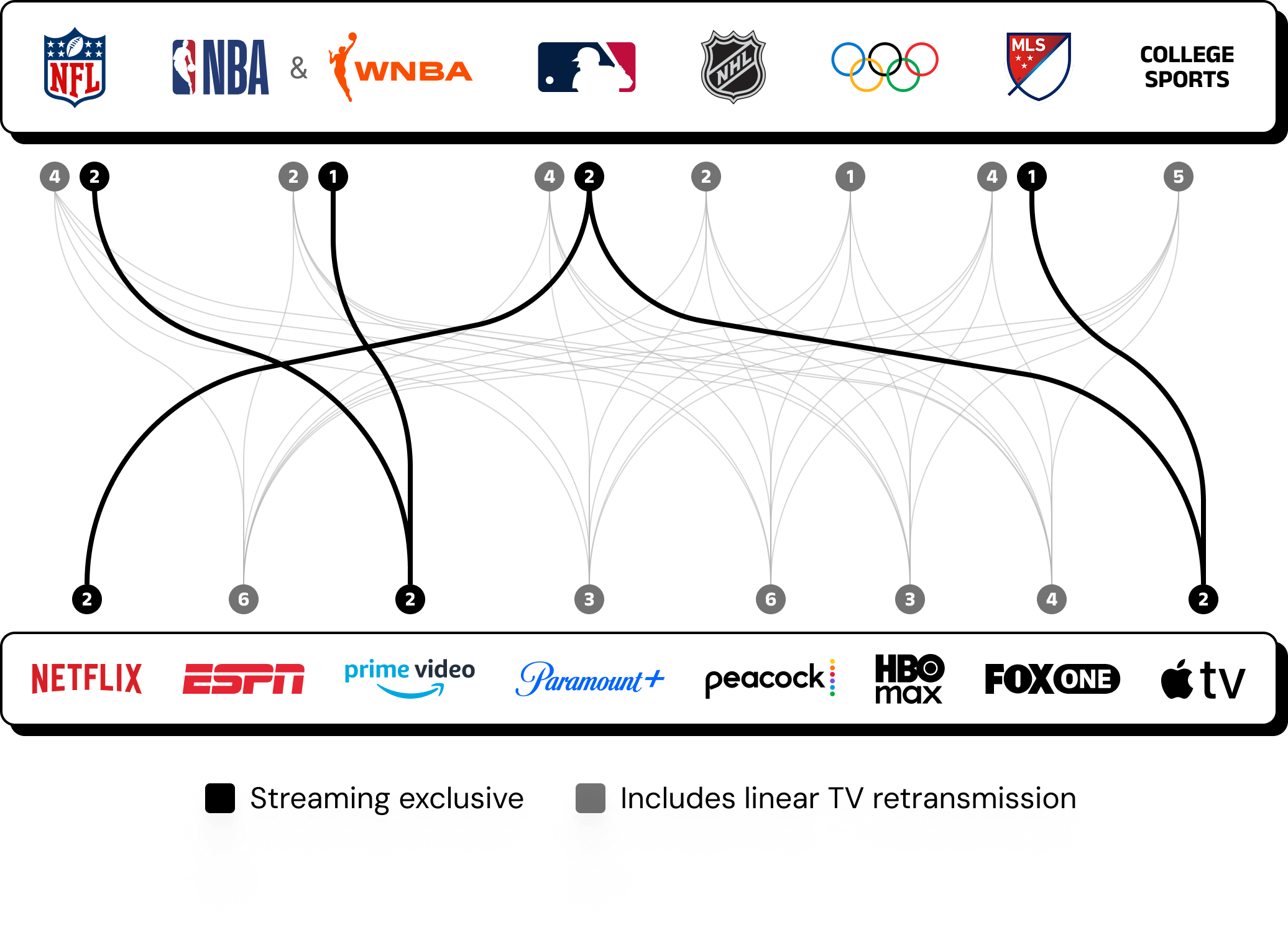
(Images inspired by Jean Carucci | The Streaming Strategy Scholar)
Measuring the Unmeasurable
Tim Rowe: As I hear you describe that though, I don't hear viewership, I don't hear millions of viewers, I don't hear measurement frameworks. I'm hearing about reaching audiences and engagement. How do you answer then the question of did it work?
Nana Kofi Amoh: And I think that's really the main issue that a lot of programmatic experts are trying to figure out today. Do you cast your wide net in for a particular game and just see if a person 25 to 54 or a person 18 to 24 saw an ad versus 55 plus? I think when it comes to viewership, you got to understand that fans come in all ages and sizes and with different interests as well. Viewership is hard simply because it's seeing what you are trying to see in terms of the content you're trying to provide, whether through particular teams or through the RSNs that are delivering this particular content. But I think at the end of the day, when you know the DMA and the audience that lives within it, I think that's where it can make the process more seamless in the sense of at least you know who's in this area and who you're potentially reaching out to.
DAZN and the Great Consolidation
Tim Rowe: DAZN has just acquired EverPass Media. The reason that that's significant is EverPass distributes live sports to commercial venues such as bars and restaurants. How do you make sense of all this going on? What does that mean for me?
Nana Kofi Amoh: As I've said, and I will stand on this hill, the RSN model is evolving. It is not dying by any means. And when I think about what DAZN is doing, they are taking this model and evolving it in a way for consumers like myself to be able to tap into the teams that I want to watch no matter where I am. Whether I'm going to a bar or whether I'm at a restaurant, it's good to know that DAZN has taken matters into their own hands really above their competitors such as the Amazons of the world or the YouTubes of the world.
Tim Rowe: Anyone could have done it.
Nana Kofi Amoh: Yes, they definitely had the budget to be able to take on these local media rights and even the NFL rights. But them taking matters into their own hands is definitely huge because at the end of the day, I think the vision is to have one centralized platform for all of these leagues and teams to be able to tap into their inventory or in their games so that people aren't having to have to download YouTube TV or Peacock or Peacock versus Apple TV or Apple TV versus Prime Video. Like DAZN wants to have the centralized perspective of knowing that hey, if you want to watch a Pacers game or if you want to watch a Rangers game, like you can watch it here.
Want to watch or listen to the entire conversation?
Get it here: https://podcast.stateofstreaming.com/nana-kofi-amoh-s5e10
Get the SOS. Brief
The sharpest streaming intelligence, delivered to your inbox.