NEW RESEARCH: Who Owns the Home Screen? YouTube, Netflix, and Roku Battle for Dominance
GET THE REPORT: YouTube’s Path to TV Dominance: The Five Moves That Got It There
In July 2026, YouTube and NBCUniversal announced a five-year deal: Peacock's entire content library — the NFL, the NBA, "Saturday Night Live," "The Traitors" — becomes available inside YouTube Premium, YouTube's $16-a-month ad-free subscription tier, at no additional cost. It's the largest distribution deal YouTube has ever signed, and it's the clearest example yet of a shift reshaping the entire streaming industry: platforms no longer just want to win subscribers. They want to be the one app people open first, and increasingly, the only app they need.

(Image courtesy of Deadline)
This piece explains why that shift is happening, uses a new pricing framework to show what it's actually worth in dollars, and lays out three things buyers and operators can (and should) do about it now.
The Framework: $MPV
Looper Insights is a research firm that tracks what appears on the home screens of connected TV (CTV) devices — the thing you see the moment you turn on a smart TV, a Roku TV, a Fire TV stick, or similar device, before you've opened any app. Looper built a metric called 'Dollar Media Placement Value', or $MPV, to answer a question that has never had a clear answer for: what is a spot on that home screen actually worth, in dollars?
$MPV is calculated as share-of-voice (how often a service appears in the best spots) multiplied by CPM-style rate cards (standard ad-pricing benchmarks) multiplied by device volume (how many households are on that device). It is not a measure of how many people watched something, and it is not ad revenue that was actually sold or booked. It's closer to how a billboard is priced — based on how many eyeballs pass it and where it sits, regardless of who's actually looking up and seeing it.
Looper ran this math on the WNBA's Q2 2026 presence across seven major CTV platforms. The result:
Roku: $23,250,685 (95.4% of all placement value)
Apple TV: $513,715 (2.1%)
Xfinity: $297,184 (1.2%)
Samsung TV (2022 models): $170,906 (0.7%)
Fire TV: $76,660 (0.3%)
Samsung TV (2020 models): $52,526 (0.2%)
Google TV: $18,496 (0.1%)
Total: $24,380,172
See that case study featured in the August Unified Streaming Power Index here
One platform generated 95 cents of every dollar of shelf value the WNBA saw across every device in America. That's not because Roku had exclusive broadcast rights to WNBA games — it didn't. It's because Roku built a dedicated WNBA hub on its home screen and the other six platforms didn't.
Looper found a similar pattern with Apple TV. When Apple redesigned its TV interface in 2025, Peacock's placement value on that interface jumped 320%. CBS, a competing network, lost roughly 90% of its own placement value in the same redesign — without losing a single subscriber or a single minute of actual viewership. The content didn't change. The shelf position did.
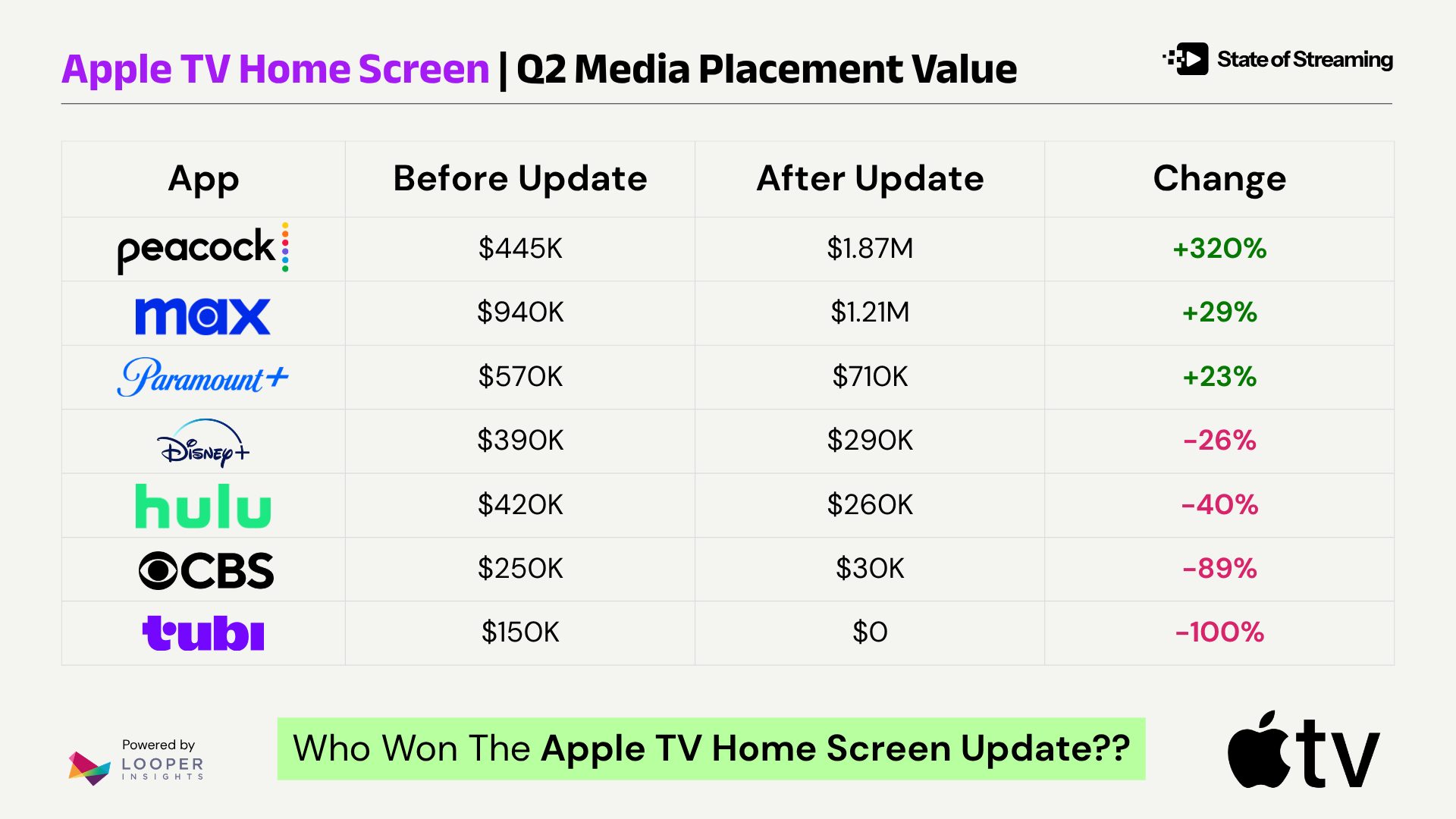
Why it matters: Home-screen placement has always been treated as a design decision, invisible to the people who buy and sell advertising. $MPV proves it's incredibly valuable inventory with a real market price, the same way retail shelf space or billboard placement has a price — and values that move by 90% or 320% in a single redesign is a trend worth tracking.
What the Industry Thinks Happens Next
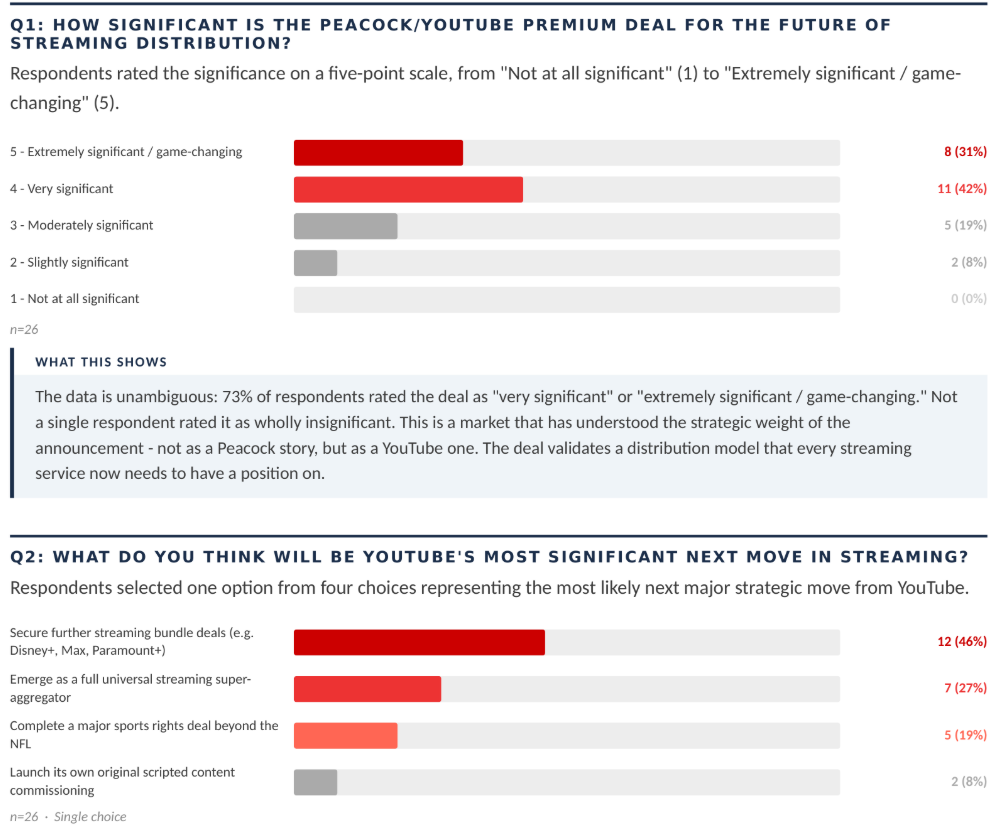
Looper surveyed 26 C-suite executives from streaming services, TV networks, ad agencies, and CTV device makers, asking them to react to the YouTube-Peacock deal. The findings:
73% called it "very significant" or "extremely significant, game-changing." Not a single respondent called it insignificant.
Asked what they expect YouTube to do next: 46% (the largest group) said more bundle deals like the Peacock one. Only 19% expected YouTube to chase new sports broadcasting rights. Just 8% expected YouTube to start producing its own scripted TV shows and movies.
Get the YouTube's Path to TV Dominance report by Looper Insights here
Why it matters: The people who run competing streaming media companies are not reading this as "YouTube got some new shows." They're reading it as "YouTube is buying distribution control," and they expect more of the same.
YouTube's Five Moves
Looper Insights published a separate report, "YouTube's Path to TV Dominance," tracing how YouTube got here. The sequence:
2022: YouTube pays over $2 billion per year, for seven years, for exclusive rights to NFL Sunday Ticket — an out-of-market NFL game package previously held by satellite provider DirecTV for nearly three decades.
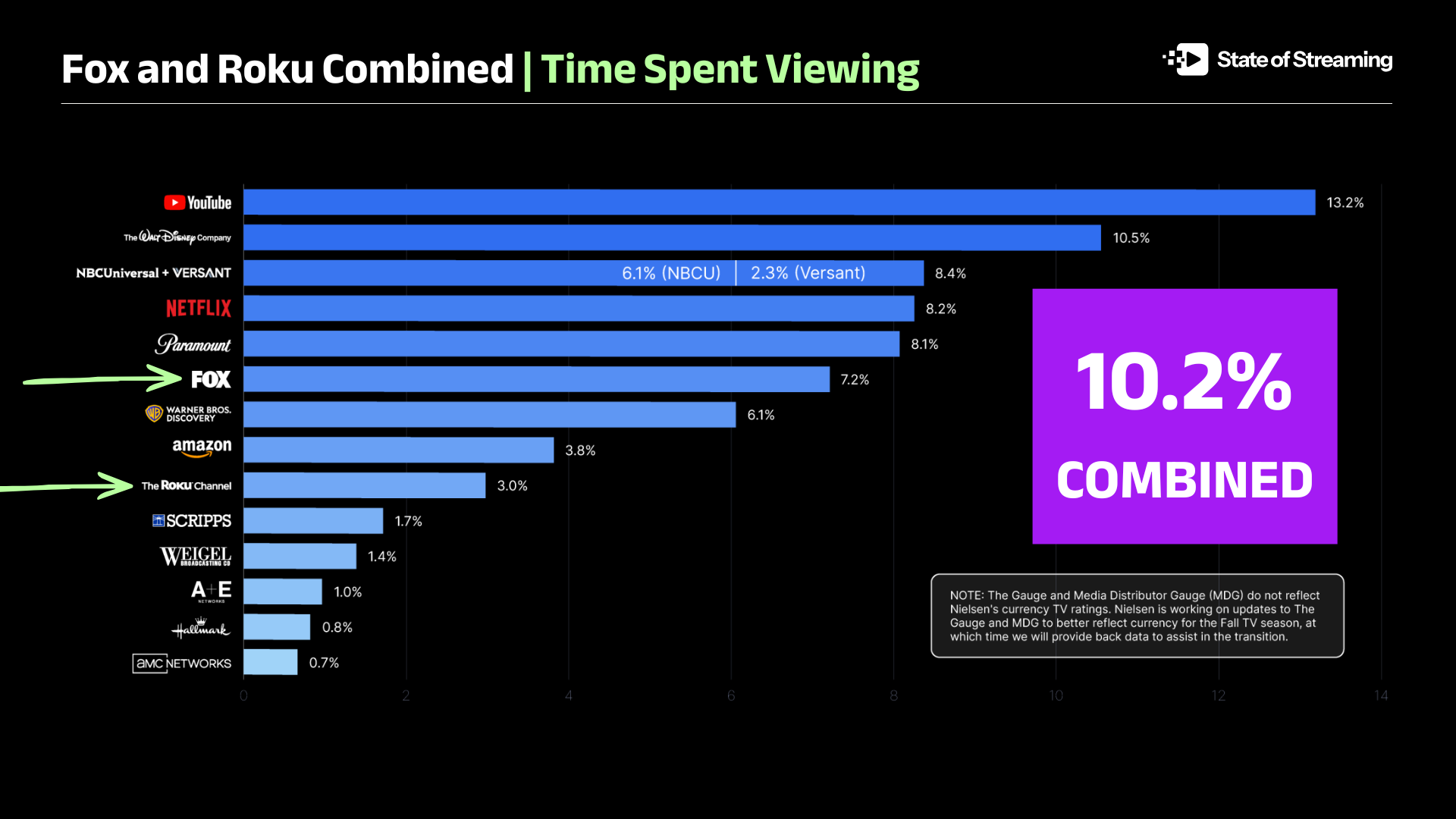
May 2026: Nielsen, the company that measures U.S. television viewership, reports YouTube now accounts for 13.8% of all television viewing time in the country — more than any single media company, including Disney at 10%.
2026: YouTube TV, the platform's separate live-TV subscription service, rolls out ten-plus genre-specific pricing plans (a sports-focused tier, an entertainment tier, and so on), positioning it to become the largest pay-TV provider in the U.S.
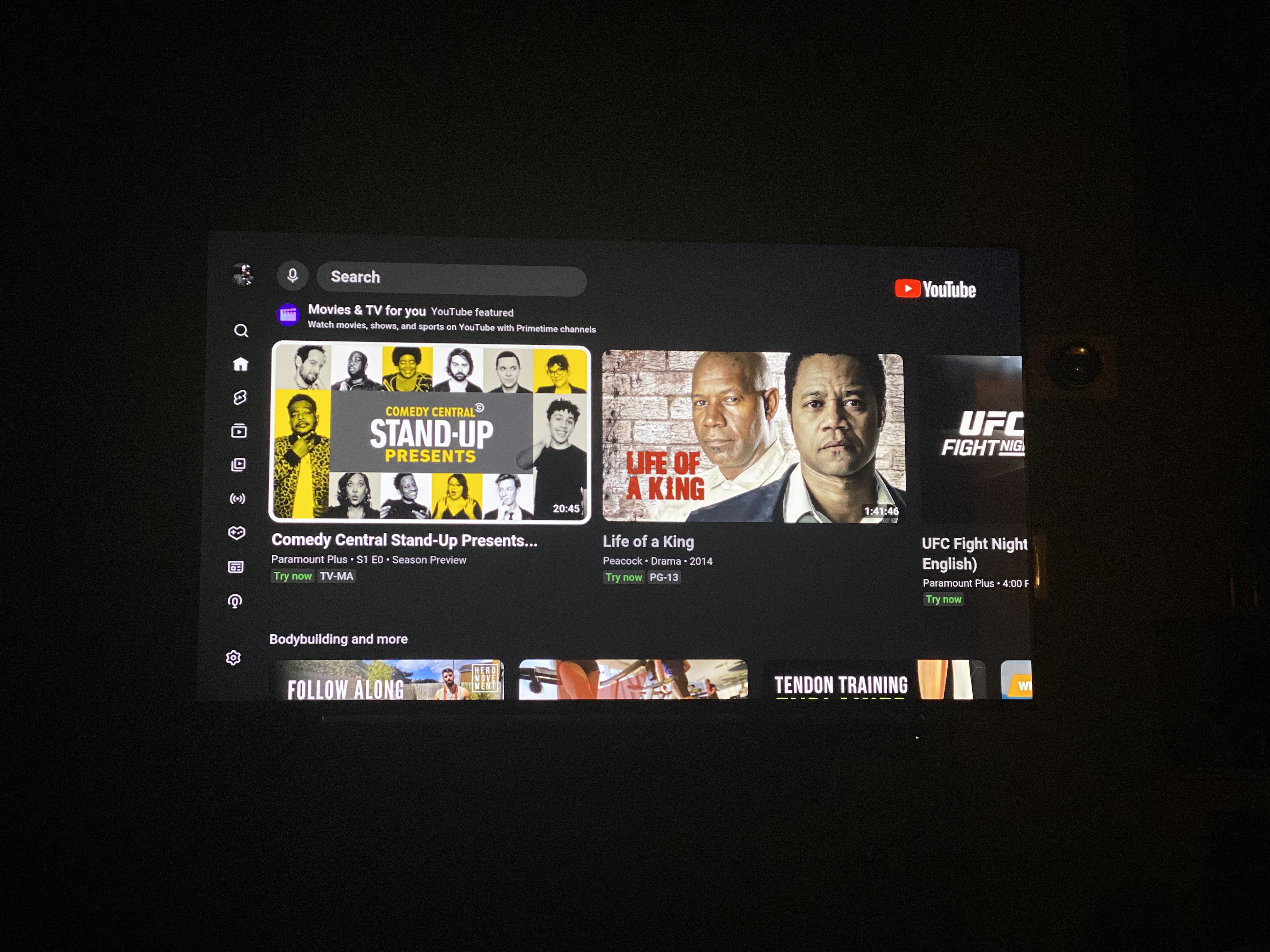
2025-2026: Primetime Channels, a marketplace built inside the YouTube app, grows to host more than 50 other streaming services — including Paramount+ and STARZ — that people can subscribe to and watch without leaving YouTube.
July 2026: The Peacock deal.
Five separate moves, each one adding more content or more subscribers directly through YouTube's own interface, rather than sending people elsewhere to watch it.
Why the Money Is Chasing the Time
Michael Beach, streaming executive and industry analyst who writes the "State of the Screens" column, published the numbers explaining why YouTube is making these moves now.
The core finding: YouTube's share of how people spend their time watching streaming television is far larger than its share of the advertising dollars being spent on streaming television.
Share of streaming TV viewing time: 28%
Share of streaming TV ad spend: 12%
YouTube's ad rate (CPM, or cost per thousand ad views) on the TV screen versus on phones and computers: 170% higher on TV
Growth rate of CTV ad spending industry-wide, year over year: 15%
Growth rate of total television viewing time, year over year: 10%
Read Michael's analysis on this out today on State of Streaming here
Why it matters: YouTube has almost a third of the audience's attention on streaming, but only about a tenth of the ad dollars. That gap is unusual, unstable and it's closing. Anyone buying YouTube inventory on CTV screens today, based on last year's assumptions about its value, is very likely underpaying — but that window is closing.
Landlords and Tenants
There's a useful framework for thinking about what's happening in media: the landscape is splitting into landlords, who own the physical or digital space where viewing happens, and tenants, who rent space inside someone else's platform to reach viewers.
Fox Corporation recently agreed to pay $22 billion to acquire Roku, the CTV device and streaming platform. Fox doesn't have much of a TV content library left — it sold most of its entertainment assets to Disney years ago. What Fox actually bought was the passageway: control over the home screen millions of Americans see the moment they turn on their television, and therefore control over which apps get discovered and which apps disappear into an unseen third row.
YouTube's own home-screen redesign — a scrollable content shelf modeled after Netflix's interface, built specifically to surface the Primetime Channels marketplace — is the same landlord strategy, applied at a much larger scale than any single device maker could manage.
That landlord instinct isn't limited to content anymore. According to Antenna, a firm that tracks streaming subscription data, several major platforms are racing to become the one place people manage all their subscriptions:
Amazon is the current leader: at least 49 million subscriptions to other streaming services (like HBO Max) are purchased through Amazon's Prime Video app rather than directly from those services.
Roku's own "channels" business, which sells other services' subscriptions through Roku's interface, grew subscription sales 19% year over year in Q2 2026.
YouTube's Peacock deal is its biggest version of the same play.
Netflix, which spent years insisting it didn't need to carry anyone else's content, integrated a French broadcast network onto its platform in June 2026 — its first move of this kind — and has reportedly held talks about carrying Peacock and Fox One as well.
Jonathan Carson, CEO of Antenna, summarized the shift this way:
"The thing that matters is that when you turn on the TV, what app are you opening for the next three hours?"
Disney remains the industry's clear holdout, still selling the large majority of its Disney+ subscriptions directly rather than through another platform. Every other major player appears to be choosing a side: become the landlord platform, or make sure your content is distributed everywhere a landlord platform exists. The middle ground — being neither — is disappearing.
A Skeptical Read on Netflix's Next Move
Not every reported deal should be taken at face value. Justin Ruiss, SVP of the Media Sector at BWG Global, who recently appeared as a guest on the SOS. podcast, shared the following analysis with his own clients about Netflix's reported talks to carry Peacock and Fox One on its own platform; it's reproduced here with his permission.
Ruiss's first concern is about the advertising rationale specifically. If Netflix's own ad inventory were selling well, why would it need to bring in a partner's content at all? His read: Peacock and Fox One would clearly benefit — they'd get access to Netflix's massive audience they wouldn't otherwise reach. But what Netflix gets in return may not be "more content to watch." It may be something else entirely: better data about what people are watching and searching for, which can be used to justify charging advertisers higher rates.
That leads to Ruiss's sharper, half-serious question. If Netflix goes through with a deal like this, does it eventually need to buy an ad-tech company outright to make the strategy work? Specifically, does Netflix need to buy Magnite, an independent ad-technology company that helps match advertising demand with available inventory across many platforms (this kind of company is called a supply-side platform, or SSP)?
Why it matters: If the real prize in a deal like this isn't "more shows to watch" but "better data to sell against," then the bottleneck for Netflix isn't the content deal itself — it's owning the technical infrastructure that turns viewer data into advertiser-priced inventory. Netflix currently works with Magnite as an outside partner; it doesn't own that infrastructure. If Ruiss's read is right, owning it outright is what would let Netflix convert a bigger content footprint into higher, defensible ad rates. It's the ad-technology version of what Fox did when it bought Roku: not a content purchase, but a purchase of the pipes and choke points underneath the content.
Four Things To Do About This
Treat home-screen placement as priced inventory, not a design afterthought. $MPV shows real, measurable swings in what a spot on the home screen is worth — a 320% jump for Peacock on Apple TV, a 90% collapse for CBS in the same redesign. If your service or your client's service depends on being discovered inside someone else's interface, ask for that number before assuming your placement is neutral.
Reprice YouTube's streaming-TV advertising inventory now. The gap between YouTube's 28% share of viewing time and its 12% share of ad spend is closing at a rate of roughly 15% ad-revenue growth against 10% viewing-time growth every year. Buyers pricing YouTube CTV inventory based on last year's numbers are very likely already behind the market.
Watch the advertising-technology infrastructure layer, not just the next content bundle announcement. If Justin Ruiss's read is correct, the next major acquisition headline in streaming won't be about content rights at all. It will be about who owns the ad-tech plumbing — the supply-side platforms and identity systems — that turns viewing data into advertiser dollars.
Download the Looper Insights Report. They've been a great partner to State of Streaming and bring a truly unique take to the dynamics playing out in streaming and connected TV.
Get the SOS. Brief
The sharpest streaming intelligence, delivered to your inbox.