Free Streaming, Expensive Underwriting - Attention Capital | A Column by Josh Stein
Editor's Note
Attention Capital is a syndicated column by Josh Stein decoding the economics of media, sports, and platform ecosystems — where attention becomes enterprise value and the contracts behind the cash flow get priced like the credit they actually are. Free ad-supported streaming looks like a single industry, but it's actually two completely different asset classes. Distribution platforms that rent inventory need equity, while content suppliers with owned IP generate durable, credit-financeable cash flows — and capital that fails to make the distinction is underwriting the wrong risk.
Welcome back to Attention Capital.
In The Behavioral Bid, we read Netflix’s $2.8 billion walkaway as a credit decision: a behavioral data system priced a content library and said no. In When a Creator Leaves, What Stays?, we read the Fixated/Studio71 transaction as a collateral problem: a roster of creators looks like an asset until the creators walk away. In The Sports Bond, we read $300 billion of league media rights as the cleanest credit instrument hiding in plain sight: a federally protected coupon waiting for a desk to underwrite it.
Three pieces, one through-line. The capital instrument has to match the cash flow profile of the underlying asset. Equity into a contracted coupon impairs returns. Credit against a creator’s audience misses the collateral. Acquisition debt against forward growth assumptions blows up.
This piece closes the loop.
On February 9, 2025, Tubi simulcast Super Bowl LIX in free 4K and broke every prior streaming record for a live event in the United States. The platform delivered an average minute audience of 13.6 million and a peak concurrent viewership of 15.5 million, with 24 million unique viewers across game-day programming, accounting for roughly one-third of all streaming viewership for the game and more than 10% of the record 127.7 million total audience. The Tubi audience for the broadcast was 94% higher than the comparable Fox-televised Super Bowl in 2023.
Free, ad-supported, platform-distributed. The largest live-streaming event in U.S. television history happened on a service that costs viewers nothing.
FAST looks like one business. It is two. One layer rents inventory. The other owns it. Only one can take debt.
Read that as a capital question. What is the underlying asset Tubi is monetizing during those four hours, and who actually owns it?
The fast answer is wrong. Tubi did not monetize the football. Fox monetized the football. Tubi monetized the simulcast pipe, and the audience routed through it. The asset Tubi owned that night was the user relationship, the ad inventory, and the data on who was watching with what device, what household, and what ad load. The asset Tubi did not own that night was the content driving 13.6 million people to its app.
Now extend the question across the rest of Tubi’s catalog. And across Pluto. And Roku Channel. And Vizio WatchFree+. And Samsung TV Plus. And LG Channels. The same question recurs at every layer of the FAST stack. The platforms own the surface. The content is mostly licensed. The cash flow runs against viewing hours, but the inventory that generates those hours sits on someone else’s balance sheet.
That is the underwriting question nobody asked when institutional capital started flowing into FAST businesses. The capital question and the asset-class question got collapsed into one when they should have been separated.
This piece separates them.
For the Attention-Constrained
The asset class:
Global FAST ad revenue is projected at $12.26 billion in 2025, with U.S. revenue at $5.78 billion, growing to $27 billion globally by 2030 at a 17% compound annual growth rate. Roughly 1,850 FAST channels are live globally as of mid-2025, and 45% of U.S. households watch FAST regularly. Tubi has surpassed 100 million MAUs; Pluto TV has approximately 80 million; Roku Channel is approaching 100 million globally. FAST is now a major commercial vertical inside U.S. television.
The structural read:
Two completely different operators sit inside the same business model. Platforms own distribution, the user relationship, and ad inventory, but license most content. Content suppliers own IP and distribute across multiple platforms. Same surface, two asset classes, two capital instruments.
The case anatomy:
Chicken Soup for the Soul Entertainment financed Crackle, Redbox, and a content library using acquisition debt backed by forward growth assumptions. The company filed Chapter 11 on June 28, 2024, in Delaware, with $970 million in debts and $414 million in assets, and then converted to Chapter 7 liquidation in July 2024 after HPS Investment Partners declined to extend DIP financing. The capital instrument failed. The business model held.
The exception:
Content suppliers that own IP and distribute across every major FAST platform produce a cash flow profile that maps cleanly onto senior secured credit. Multi-platform diversification, multi-cohort durability, owned collateral, no rights cliff, margin protected by ownership. That is the credit-financeable layer of FAST.
The transition:
The operator side of the same argument runs through creators self-commissioning their own production with senior secured credit against existing cash flow, rather than dilutive equity or commission-based talent fees. They own the IP. They own the distribution rights. They own the upside.
The implication:
The platform layer needs equity. The content layer with owned IP needs credit. Capital that does not make the distinction will keep impairing the same way Chicken Soup for the Soul did.
The FAST Market In Numbers

The headline numbers do most of the work. Global FAST advertising revenue is projected at $12.26 billion in 2025 and forecast to reach $27.14 billion by 2030, with the United States contributing $5.78 billion in ad revenue this year alone. The broader AVOD market, of which FAST is the fastest-growing slice, is projected to grow from $38 billion in 2023 to $69 billion by 2027. Roughly 1,850 FAST channels were available globally in mid-2025, up from a few hundred five years earlier, and 45% of U.S. households regularly watch FAST content.
Behind those aggregates sits a small set of platform operators with most of the ad inventory. Tubi, owned by Fox Corporation, has surpassed 100 million MAUs globally as of mid-2025. Pluto TV, owned by Paramount Skydance, sits around 80 million MAUs and posted its highest hours-watched quarter in Q1 2025. The Roku Channel grew its share of total U.S. TV viewing from 1.6% in September 2024 to 3.0% in December 2025, the fastest growth rate on the FAST curve, and is approaching 100 million MAUs globally. Vizio WatchFree+ rides on top of Vizio’s 18 million-plus SmartCast active accounts, which Walmart acquired for $2.3 billion in December 2024. Samsung TV Plus and LG Channels round out the device-tier slate. Amazon Freevee, the standalone AVOD service, was wound down in August 2025, with its content folded into Prime Video alongside the ad-supported tier Prime Video introduced in January 2024.
The Walmart-Vizio and Amazon-Freevee transactions are worth a second pass. Both happened inside an 18-month window. Both signal the same conclusion. The standalone economics of running a FAST app are not strong enough to justify operating costs without a larger structure on top. Walmart bought Vizio because the FAST business is worth more inside a retail-media advertising stack than as a standalone platform. Amazon retired Freevee because the FAST business was worth more folded into Prime Video than running parallel. Two of the largest companies in the world looked at the standalone FAST P&L and concluded that it does not finance itself.
That is the foundation under everything that follows. FAST as a consumer surface is enormous and growing. Standalone FAST as a capital structure is fragile. FAST embedded inside Fox, Paramount, Roku’s operating system, or Walmart’s retail-media stack runs differently. The credit question is: which version of FAST is the desk actually underwriting?
The fragility traces to where the cash flow comes from. Platforms generate ad revenue based on viewing hours. Viewing hours come from content. Content is mostly licensed from suppliers, with terms that run two to five years and that get repriced inside platform competition for the next renewal. Every platform’s highest variable cost is content acquisition. Every platform’s largest contracted commitment renews on a cycle shorter than the duration of the debt that any institutional credit shop is comfortable underwriting against the platform itself.
A senior secured loan to a FAST platform is, in effect, a loan against a pipeline of contracts the borrower does not own and cannot extend without re-bidding. That is not the profile credit underwriters built their playbooks for. That is closer to the profile of a movie theater chain in the 1990s, borrowing against future ticket revenue from films it had not yet licensed. Theaters survived that decade. Many of them did not survive it well.
Pull the lens back from the platform tier. Look at where the cash flow on the supplier side actually originates. The picture changes.
The Two-Tier Asset Structure
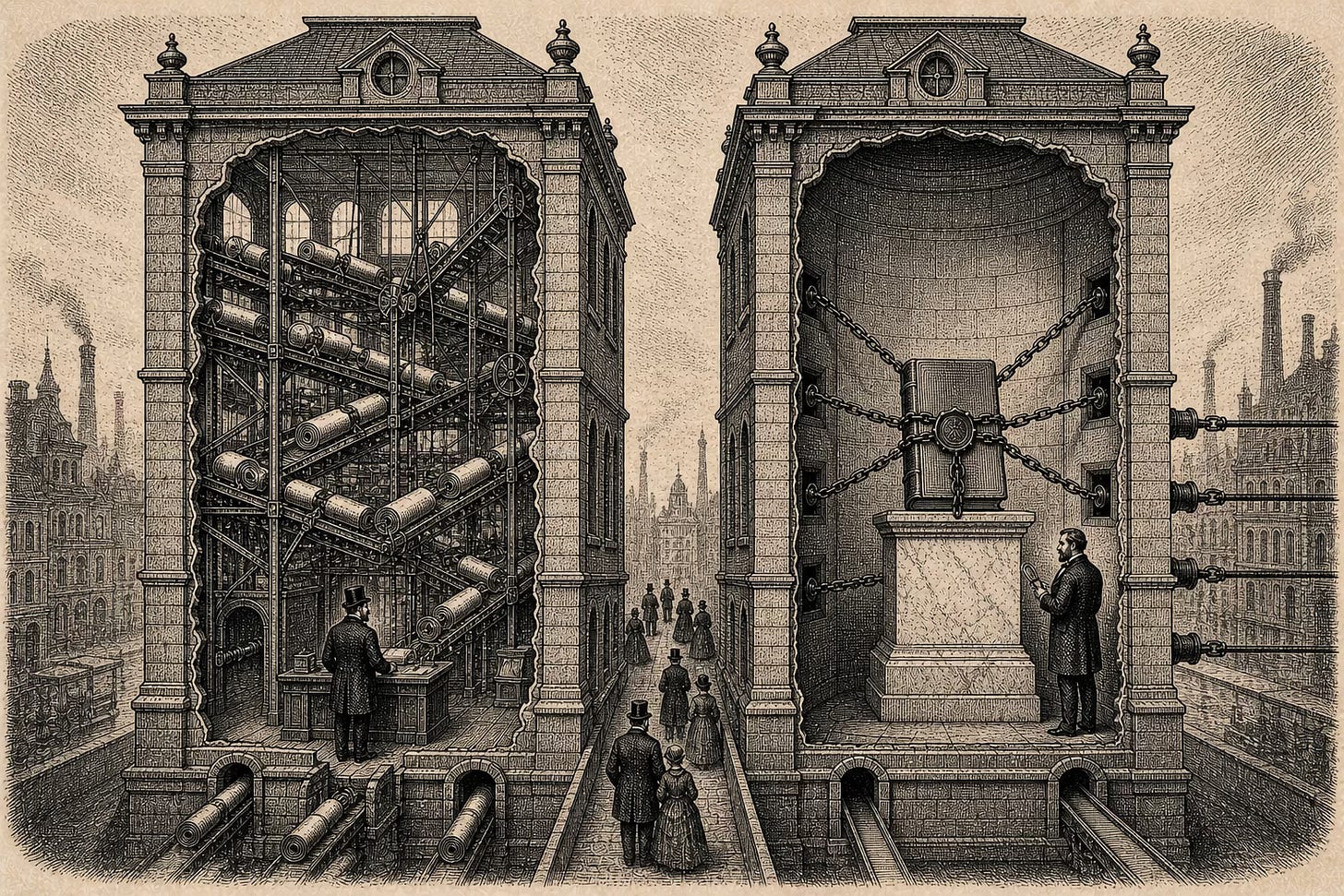
Two operators sit inside one business model. They share consumers, apps, and viewing hours, and they look identical at the consumer surface. They are completely different as credits.
Type One is the platform. Tubi, Pluto TV, Roku Channel, Vizio WatchFree+, Samsung TV Plus, LG Channels, the wound-down Freevee, and the discontinued Crackle. The platform owns the distribution layer, user relationships, the ad-tech stack, inventory yield management, device integrations, and the brand on the home screen. The platform does not, in the main, own the content driving viewing hours. The platform licenses content from suppliers under multi-year deals that reprice at renewal.
The platform’s cash flow profile is the place to start. Revenue is ad-supported and proportional to viewing hours. Gross margin runs against content acquisition cost. Content acquisition costs run counter to the supplier’s leverage in the renewal negotiation. The supplier’s leverage runs against how exclusive the content is, how much viewing it drives, and how many other platforms are competing for it. Stack those four dependencies, and the platform’s gross margin compresses every renewal cycle in which content suppliers consolidate or hold leverage.
That is why Tubi keeps spending more on content even as its MAU base grows. Pluto TV’s content acquisition costs have outpaced ad revenue growth in multiple recent reporting cycles, even as parent Paramount has sought to leverage Pluto’s audience to subsidize the streaming pivot. Roku now has to invest in originals to defend inventory yield against platforms with deeper licensed catalogs. Vizio’s value to Walmart stems from the SmartCast operating system and the retail-media ad data underlying it, with the FAST channel as a smaller line item within the deal logic.
Read that profile as a credit underwriter. The asset on the balance sheet is the user base, the ad-tech stack, and the brand. The asset is not the content driving viewing. The content is rented. Every license renewal is a refinancing event for the largest line on the cost side, and the lender has no covenant control over how the renewal goes. Senior secured credit against a platform’s incremental EBITDA from FAST inventory is closer in profile to a covenant-light corporate revolver for a tour operator than to a senior loan against a music catalog.
Some platforms have moved to address that fragility by investing in original content, but originals carry their own risks. The platform now bears production costs upfront, exposure to performance variance, and the slow-build problem of competing with subscription services that have been spending on originals for a decade. The shift from licensor to producer is real, but it converts the platform from a licensed-inventory business with renewal-cliff risk into a hybrid platform-and-studio with greenlight risk on top.
The right capital for that profile is equity, with patient time horizons and tolerance for content-spend volatility. The wrong capital is leveraged against forward-growth assumptions on a renewal cycle that the borrower cannot guarantee.
Type Two is the supplier with owned IP. Cocomelon parent, Moonbug Entertainment, is owned by Candle Media. Moonbug operates the Moonbug Kids 24/7 channel and distributes branded shows, including Cocomelon, Blippi, Little Baby Bum, and My Magic Pet Morphle, across The Roku Channel, Pluto TV, Samsung TV Plus, and roughly 100 other platforms in 26 languages. Specialty fitness libraries. Faith-based content operators. Hispanic-language libraries. Foreign-film catalogs. Older sitcom rights aggregators. Documentary libraries. Niche genre operators across crime, classic Westerns, and outdoor lifestyle. Each of these operators owns content rights and distributes it across multiple FAST platforms simultaneously.
The supplier’s cash flow profile is the inverse of the platform’s. Revenue is diversified across multiple platforms, with no single distribution counterparty posing existential concentration risk. Content cost is owned and amortized on the supplier’s balance sheet. Gross margin is protected because the operator does not pay a license fee to itself. Audience is bound to brand and content, so platform shifts redistribute revenue across the supplier’s existing distribution map rather than shrinking it. Platform-side renewal cycles become leverage events for the supplier. Refinancing risk lives at the platform tier.
Stack those features against a credit underwriter’s checklist, and the picture is clear. Diversified counterparty mix. Owned collateral. Documented behavioral cash flow with measurable durability. Margin is protected against the largest cost item by ownership. A multi-cohort audience that does not age out the way a single-show franchise does. Platform-shift insurance is built into the distribution structure.
Kids’ content makes the case most cleanly because the cohort behavior is documented. New audience cohorts age into the content every year as new toddlers reach screen-watching age. Existing cohorts age through it across multi-year viewing windows. Brand recognition transfers across distribution channels because the IP is the brand. A Cocomelon viewer in 2018 is no longer in the audience in 2026, but the audience size on Cocomelon is the same or larger because a new cohort replaced the prior one. Call it what it is. A renewable subscription, paid in attention, settled in ad revenue across every platform the IP is distributed on.
The same logic applies in narrower forms across other content verticals. Specialty fitness libraries retain subscribers for years through repeat-viewing of routines. Faith-based libraries see multi-year retention tied to denominational and family-viewing patterns. Foreign-film libraries hold together within diaspora audiences, cohort by cohort. Sitcom catalogs from earlier eras retain audience because the IP is finite and the demand is sustained. Documentary libraries compound across generational discovery cycles tied to subject matter.
Different verticals, same structural feature. Owned IP. Multi-platform distribution. Multi-cohort durability. Margin protected. Platform-shift insurance.
Two operators inside one industry. Different asset structures. Different capital instruments. Different correct counterparties on the credit side.
The platforms own the surface. The suppliers own the inventory. Capital that confuses the two will keep underwriting the wrong layer.
That confusion is the structural error inside almost every FAST-related credit deal that has been written. The Crackle case is the cleanest documentation of where the error leads.
The Crackle Case Study

Crackle started as something else and was repurposed twice before it broke. The history matters because each repurposing changed the asset profile and the right capital instrument, and the financiers underwriting each leg either did not see the change or did not respect it.
Sony acquired Grouper for $65 million in 2006 and rebranded it as Crackle the following year, running the service inside Sony Pictures Entertainment as a free-streaming experiment with a slate of originals that included Comedians in Cars Getting Coffee, The Oath, and Start Up. From 2007 through 2018, Crackle operated as a strategic experiment for Sony, funded out of the corporate operating budget and justified as a window into streaming economics rather than a standalone profit center. The right capital was patient strategic equity inside a major studio’s balance sheet. That is what Sony provided.
In 2019, Sony chose to exit. Sony Pictures Television sold a majority stake in Crackle to Chicken Soup for the Soul Entertainment in March 2019 in a joint-venture transaction that created Crackle Plus, with CSSE contributing its own AVOD assets, including Popcornflix and Espanolflix, Sony contributing the Crackle brand, user base, and ad business, and CSSE issuing approximately four million five-year warrants on Class A common stock to Sony as part of the deal. Sony fully divested its remaining stake in late 2020, exchanging its joint-venture position for additional CSSE stock and surrendering operational control.
The asset’s strategic shape changed at that moment. Inside Sony, Crackle was a strategic experiment funded by a balance sheet large enough to absorb its losses. Inside CSSE, Crackle became the centerpiece of a roll-up strategy. Where Sony had patient strategic equity, CSSE had a small balance sheet, public-company quarterly reporting pressure, and a stated growth thesis that depended on cash flow from the FAST business arriving on schedule.
The growth thesis got bigger in 2022. CSSE acquired Redbox in August 2022 in a transaction valued at roughly $375 million, including the assumption of approximately $325 million of Redbox debt, with the rationale being to combine Redbox’s transactional video and physical kiosk business with CSSE’s FAST and AVOD streaming portfolio. The capital structure at that point bore little resemblance to what was needed. CSSE was now operating a kiosk network with declining DVD-rental volume, a FAST platform facing licensed-content cost pressure, an AVOD library assembled through prior acquisitions, and a small originals slate. The debt service stacked on top of all of it required forward growth across all four lines to come in roughly on plan. Any one of them missing badly would force a restructuring of the whole.
All four missed. Redbox kiosk volumes declined faster than the synergy modeling assumed. The FAST platform’s content acquisition costs outpaced ad revenue, and it did not differentiate sufficiently from larger competitors. The AVOD library produced more amortization expense than incremental revenue. The originals slate did not move the needle. By Q1 2024, the consolidated balance sheet showed total debt of $970 million against consolidated assets of $414 million.
The Chapter 11 filing landed on June 28, 2024. Within weeks, the case converted to Chapter 7 liquidation when HPS Investment Partners, the company’s primary lender and the arranger of the DIP financing facility, declined to extend further capital and concluded the going-concern thesis no longer held. Approximately 24,000 Redbox kiosks went dark, and roughly 1,000 employees lost their jobs. Crackle, Redbox’s streaming brand, and other CSSE assets were set for auction at the offices of Milbank LLP in New York on April 23, 2025. Crackle made an unauthorized brief revival in late March 2025 and went dark again within weeks. As of spring 2026, Crackle remains dark, with no confirmed buyer or relaunch.
The structural read on the failure is direct. The capital instrument applied to the asset is what failed. The FAST business model held inside larger balance sheets at Fox, Paramount, and Roku across the same period. The Crackle asset, with 20 years of brand recognition and a defensible AVOD position, held value during the auction process. What collapsed was the leverage stack CSSE built around the asset.
CSSE financed a roll-up of FAST and AVOD assets with acquisition debt structured against optimistic forward cash flow projections, on a balance sheet small enough that any one of the underlying businesses missing materially would force a restructuring of the entire stack. The right capital for the strategic ambition was equity, ideally a much larger pool of equity, willing to absorb operating volatility across multiple FAST and AVOD assets through a multi-year integration phase. Senior secured credit, if any, should have been priced narrowly against documented current cash flow with covenants tied to license-renewal schedules and content-acquisition spend. Acquisition debt structured against forward growth was the wrong instrument for any FAST asset on its own, and a worse instrument for a roll-up of multiple FAST and AVOD lines whose growth assumptions were correlated to the same broader thesis.
HPS, as the senior lender at the moment of distress, did exactly what a disciplined credit shop is supposed to do. It tested whether the going-concern thesis held when the cash flow projections that underwrote the debt did not arrive on schedule, and it pulled support when the answer was no. The bankruptcy mechanics worked. The capital structure that produced the bankruptcy was the wrong one to put on the asset in the first place.
This pattern is the one to flag. The CSSE collapse is anatomy. Other roll-ups and platform-aggregation strategies in the FAST and AVOD sectors have used acquisition debt structured against optimistic growth assumptions, with insufficient covenants tied to the actual cost drivers in the business. Some of those structures will hold. Some will not. The ones that do not will repeat the Crackle failure mode in different brand wrappers.
The instrument is the variable. The asset is the constant.
The Owned IP Exception, And The Operator Transition

The other side of the same FAST industry produces a credit profile that maps almost cleanly to senior-secured asset-backed lending criteria. The structural features are not theoretical. They sit on operating P&Ls today, across multiple verticals, and they have been ignored by institutional credit because the desks covering FAST have looked at the platform layer and concluded the entire vertical does not finance.
The archetype operator runs a specialty content business with owned IP distributed across every major FAST platform. Tubi, Pluto, Roku Channel, Amazon Prime’s free tier, Samsung TV Plus, Vizio WatchFree+. Multi-platform diversified. Multi-cohort sustained. IP-owned. Behaviorally durable. Margin protected. That cash flow profile is what credit underwriters built their playbook for. Almost nobody is currently writing senior paper against it.
That archetype exists across multiple verticals. Kids content, where Cocomelon and Blippi sit at the top of the cohort durability list. Specialty fitness libraries, where the per-subscriber retention curve runs years. Faith-based content, where denominational viewership patterns produce decade-plus durability across family-viewing windows. Hispanic-language libraries, where the cohort follows the diaspora geography. Foreign-film catalogs, where the audience is bound to language and culture rather than the platform. Older sitcom catalogs of the kind that a Norman Lear-style estate could distribute. Documentary libraries with subject-matter durability across discovery cycles.
Kids’ content holds the cleanest version of the durability mechanism. New audience cohorts arrive every year as new toddlers reach screen age. Existing cohorts age through the content over a multi-year viewing window. The brand recognition is portable across platforms because the IP is the brand. Cocomelon, Blippi, Little Baby Bum, and the Moonbug-owned slate as a whole all carry brand equity that travels regardless of which FAST app the parent opens first.
The operating model maps directly onto credit. Production cost is amortized against the IP. Distribution revenue is diversified across multiple platforms, so a Tubi or Pluto repricing does not materially move the consolidated cash flow line. Cohort retention is tracked at the platform level and reported back to the supplier. The audience does not erode the way a single creator’s audience erodes when the creator pivots, because the audience is bound to the IP, and the IP is owned.
Stack those features against the AQS framework. Audience durability scores high because new cohorts arrive on schedule. Conversion efficiency to ad revenue is strong because the audience watches in long, recurring viewing patterns. Community cohesion is moderate to strong, depending on how parental endorsement is built into the brand. Platform risk is low because the supplier’s revenue is diversified across the entire FAST distribution map. Content moat is owned and protected.
Senior secured credit fits this profile cleanly. The collateral is the IP itself, with information rights on platform behavioral data, advance rates determined by cash flow durability over the prior 36 to 60 months, and covenants tied to platform diversification thresholds and audience-retention reporting. The right facility size is anchored to the supplier’s documented current cash flow with growth capital available against the production pipeline.
That is the credit-financeable layer of FAST. It exists. It is operating. The capital instrument matched to it has, in most cases, not yet been written.
A disciplined credit reader will push back on the cleanliness of this profile, and the pushback is fair. Three risks attach to even the strongest supplier credits. The platform revenue-share dependency is real, since the supplier reports revenue net of platform splits that are repriced during renewal negotiations. Ad market cyclicality runs through the underlying CPM data, and the FAST CPM compression of 2022 to 2023 cut supplier cash flow materially across the category before recovering through 2025. Algorithmic surfacing on the home-screen carousel of each FAST app determines a non-trivial share of viewing hours, and that surface is controlled by the platform. Audience fatigue within a single IP is non-zero on a long enough horizon, and within kids’ content, the cohort has options across Cocomelon, Blippi, Ms. Rachel, and the next entrant yet to be introduced.
Those risks shape the covenant package, the advance rate, and the spread. The right paper sits within the asset-backed lending range, which already prices music catalogs, film slates, and franchise IP at BB to BBB equivalents, with 50% to 65% advance rates against documented cash flow. The supplier stays in the credit column. The pricing reflects the risk.
Some operators run both layers. Moonbug owns IP and operates the Moonbug Kids 24/7 channel as a distribution arm. Hybrid operators get scored separately on each layer for credit purposes. The owned-IP layer takes credit. The platform layer takes equity. The capital structure on the consolidated balance sheet has to respect the boundary between the two.
The story extends outside specialty libraries and into the operator class. The same structural argument applies to creators, with one important translation: the creator who wants to access this capital instrument has to make a transition that the prior generation of creators did not have to make.
The prior generation got paid as talent. Show up, perform, take a commission rate against someone else’s IP, someone else’s distribution, someone else’s upside. The studio commissioned. The network commissioned. The platform commissioned. The talent collected a fee, and sometimes a percentage, for doing the work in front of the camera. The IP belonged to the studio or platform that commissioned the project. The distribution rights belonged to whoever held the license. The upside flowed back to the holder of the rights, not the talent who appeared in the work.
The structural feature underneath that arrangement was the commissioning capacity of the studio and the platform. For 80 years, talent fees were paid because the studio and the platform had the capital and distribution to commission content that nobody else could afford to make.
That commissioning capacity is migrating. The platforms that used to commission content now run primarily on viewing hours and ad inventory. The rates they pay for licensed content have compressed inside a competitive bidding environment that benefits scaled suppliers and disadvantages individual talent. The creator who used to receive a five-figure or six-figure commission against someone else’s library now bids into a market where the platform has commodity options and treats incremental supply as commodity inventory. The fee compresses. The IP does not transfer. The upside does not reach the creator.
The creator with audience equity has leverage that earlier-generation talent did not have. The audience is theirs. The data is theirs. The cohort is documented. The cash flow is real. That asset position can support a different capital instrument than the talent fee.
Senior secured credit, structured against a creator’s existing cash flow, can fund the production of new content owned by the creator, distributed across platforms the creator chooses, with the upside returning to the creator’s balance sheet. The technical name for that structure is straightforward. Existing business services the debt. The new production is the use of proceeds and the upside. If the production performs, the creator captures the asset value through ownership. If it does not, the existing revenue services the loan, and the new production becomes a write-off against a base that survives it.
This is the operator-side translation of the same structural argument running through the supplier section. An expansion loan from the creator to the studio, in the language operators understand. The capital instrument shifts the entire economic structure of who owns the result.
The deals worth underwriting at the FAST supplier layer are exactly the operators making this transition. They want credit capital that funds production while preserving IP, distribution rights, and upside on the resulting asset. The venture-equity conversation runs in a different direction. Venture capital prices growth and takes ownership in exchange for production capital. That posture fits a different type of business at a different stage. It does not fit the cash flow profile of an established multi-platform supplier with documented audience durability.
Two different asset classes inside one industry. Two different capital instruments. The credit-financeable layer of FAST is the operator class building owned IP, self-commissioning their own production, and distributing across multiple platforms. The equity-financed layer is the platforms running the distribution arms race. Capital that does not make this distinction will keep impairing the same way Crackle did.
What Changes When Capital Matches Cash Flow

Apply the right capital instrument to each layer, and the failure modes that run through the FAST sector are reduced materially.
Run the Crackle counterfactual first. Strip out the acquisition debt. Replace it with a smaller, senior-secured facility against documented current cash flow at the time CSSE took control, with covenants tied to license-renewal schedules and content-acquisition spend. Cap the facility size at a conservative multiple of the prior-year cash flow run rate. Add information rights on platform-by-platform performance data and a mandatory cash sweep on overperformance against the base case. The Redbox acquisition under that capital structure is unfinanceable. The covenant package limits incremental indebtedness to a level that cannot fund the $375 million transaction. The acquisition does not happen.
That single decision, gated by a disciplined credit structure, changes the trajectory of the entire enterprise. CSSE, without the Redbox debt overhang, continues to operate Crackle and its AVOD library within a smaller capital envelope. The renewable cost pressure of the FAST platform is real, but it is manageable inside a balance sheet that is not also servicing a roll-up debt stack. The covenants flag deterioration before it becomes existential. The lender intervenes, equity is diluted in a restructuring rather than wiped out in liquidation, and the assets continue to operate in some form. None of that produces a thriving business, but it does produce a different ending.
The right capital, in that counterfactual, was the discipline. The wrong capital was the leverage.
Run the same exercise on the owned-IP supplier side, and the change runs in the opposite direction. Today, most owned-IP FAST suppliers operate on equity-funded production schedules with capital provided by founders, strategic acquirers, or growth equity funds that typically demand control or near-control positions in exchange for production capital. The Moonbug acquisition by Candle Media in 2021, priced at roughly $3 billion, is the high-water mark example of equity-priced FAST IP. Candle Media has since rebranded its animation business under the Moonbug umbrella and consolidated kids-content operations. That transaction, on a smaller supplier with similar cash flow durability but without a founder ready to sell, is currently the only standard exit available.
Senior secured credit changes that arithmetic. With a properly structured facility, working capital becomes available for opportunistic content acquisition on terms the supplier controls. Library expansion is funded through debt rather than equity dilution, preserving the founder’s ownership of the upside. Platform diversification becomes a covenant-protected discipline rather than an aspiration, because the lender requires multi-platform distribution as a condition of the facility. Production financing extends the operator’s IP base by financing it on a capital basis against the existing cash flow, with the new production owned by the operator rather than the financier.
The deal architecture is not exotic. The same structural toolkit used in asset-backed lending against music royalties, film slates, and franchise IP applies almost cleanly. Information rights on platform data. AQS-style covenants on attention durability across the cohort. Reset clauses tied to demographic shifts in the audience or material adverse changes in viewing behavior. Cross-default to platform contract terms. Cash sweep on overperformance that compounds principal repayment and reduces the cost of capital across the term.
A senior secured facility against an owned-IP supplier with documented multi-platform cash flow should price tighter than a comparable corporate facility for a single-product media company. The cash flow is more diversified. The collateral is owned and identifiable. The retention behavior is documented. The platform risk is hedged by the distribution map. The default frequency on the supplier’s underlying revenue line is structurally low because no single platform represents existential exposure.
The diligence framework looks like the framework already used in adjacent asset-backed structures. Three to five years of platform-by-platform reported revenue. Cohort retention curves measured at the IP and platform level. Production cost amortization schedules mapped against revenue contribution by title. Multi-platform distribution maps audited against contract documentation. Audience-quality scoring run against the AQS framework, with the score itself anchored to behavioral metrics rather than to demographic narratives.
That is the framework AQS produces, and the framework that turns FAST-owned IP suppliers into a credit-grade asset class. The methodology is the bridge between the operating profile and the capital instrument. Without the methodology, the credit desks see media-supplier risk and price it the way they priced Crackle. With the methodology, the same balance sheet produces an asset-backed structure that prices closer to comparable royalty paper than to corporate media credit.
Same business model, financed differently, completely different outcome.
The Institutional Implication

For institutional credit allocators, the asset class is identifiable now. Asset-backed finance teams at major credit shops, media and entertainment banking desks, BDCs running specialty finance books, and family-office credit pools already deploying into music royalties and film slates are the natural counterparties for owned-IP FAST supplier paper. The diligence framework maps to the framework already in use for adjacent royalty-style assets. The cash flow profile is documented. The collateral is owned and identifiable. The duration of the underlying contracts is multi-platform and renewable.
What the desks need, before deploying at scale, is a screening framework that distinguishes the credit-financeable supplier from the equity-only platform. That screen has four anchors. Owned IP rather than licensed content. Multi-platform distribution that hedges single-counterparty exposure. Multi-cohort behavioral durability documented across at least 36 months of platform-reported data. AQS-style scoring on attention quality run against the cohort and the platform mix. An operator with all four anchors is credit-financeable. An operator missing any of them is the wrong asset for senior secured paper.
For M&A advisors, the deal flow worth sourcing sits below the platform consolidations. Platform M&A is equity-stage, and the price discovery on those transactions has already absorbed most of the available margin. Walmart-Vizio cleared at $2.3 billion. Paramount has tried and so far has been unable to monetize Pluto TV separately. Roku trades on its operating-system economics, with the FAST channel as one input among several. The platform layer is large. The equity-stage opportunity is mostly priced.
The underserved deal flow is on the supplier side. Owned-IP FAST suppliers with multi-platform distribution, documented cash flow, and founder-controlled cap tables are largely undeserved by institutional capital. They typically take growth equity from a small set of media-focused funds when they take outside capital at all. The institutional credit door has not been built for them. Senior secured credit against documented cash flow is the right counterparty conversation, and the advisor who can structure that conversation owns the supplier-side deal flow for the next several cycles.
For creators considering the operator transition, the capital instrument worth a conversation is senior secured paper. The creator who built audience equity over a multi-year content cycle holds leverage that the venture model is structured to extract through dilution. Senior secured credit, structured against existing cash flow with the new production as the use of proceeds, preserves the creator’s ownership of the upside on the new IP. The deal architecture is established in the adjacent asset-backed lending market. The conversation is straightforward once the creator’s advisor knows the right counterparty to call.
For FAST platforms themselves, the underwriting question runs deeper than whether a piece of licensed content will perform. The deeper question is how to structure deals with suppliers whose capital structure aligns with the platform’s distribution structure. Platforms have been inadvertently de-risking weak suppliers and, in effect, overpaying for content that reflects the supplier’s capital structure as much as its content quality. A supplier carrying fragile equity-funded production economics charges more per hour because it has to. A supplier with senior secured credit and a stable production pipeline can deliver content at a price that reflects the actual marginal cost. The platforms with the most disciplined supplier strategies will end up with both better content and better unit economics.
The capital architecture and the content architecture are linked. The platforms that recognize the link first will compound the advantage.
For policymakers and antitrust observers tracking the FAST consolidation, one note matters. The platform layer is consolidating because it does not finance itself standalone. Walmart-Vizio and Amazon-Freevee are the rational response to a business model whose unit economics require larger ancillary structures to clear the cost of capital. More transactions of the same shape will land across the platform layer over the next 24 months. The supplier layer, by contrast, has every reason to remain fragmented. Owned IP travels across platforms, and suppliers with multi-platform distribution do not need to consolidate to reach scale. The structural prediction is convergence at the platform layer and persistent fragmentation at the supplier layer. Capital should be priced accordingly at each tier.
Closing
Free TV is now a global business projected at more than $12 billion in 2025 ad revenue, with U.S. ad revenue alone north of $5.7 billion and a 17% compound annual growth rate forecast through 2030. Inside that market sit two completely different asset classes wearing the same consumer surface. The platforms own distribution and rent inventory. The suppliers own IP and distribute across the entire platform map.
The platform layer needs equity, with patient time horizons and tolerance for content-spend volatility through renewal cycles. The supplier layer with owned IP needs credit, structured against multi-platform cash flow and behaviorally documented cohort durability. Capital that does not make the distinction will keep impairing the same way Chicken Soup for the Soul did. Capital that does will discover an asset class that has been operating in plain sight while the credit desks looked past it.
The operators who already get this are building the businesses worth underwriting. Some of them are content suppliers with established libraries. Some are creators making the transition from commissioned talent to self-commissioning operators, financing their own production with senior-secured credit against existing cash flow rather than diluting the upside for the audience they spent years building.
What does the curve look like once the credit desks draw it? BBB-equivalent paper sits with the largest multi-platform owned-IP suppliers, where multi-cohort durability runs the longest and platform diversification is broadest. BB-equivalent sits with strong specialty suppliers in stable verticals. B-equivalent sits with growth-stage suppliers in younger verticals where the cohort behavior is documented, but the duration of the documentation is shorter. Below B sits with suppliers whose documentation is thinner or whose distribution map is narrower. Platform-tier exposure of any kind sits in equity, with the public comps already trading on a multiple basis rather than on a credit basis.
Three pieces, one through-line. The Behavioral Bid showed the data system pricing the library. When a Creator Leaves, What Stays? showed the audience walking with the creator. The Sports Bond showed the contract fixing the cash flow. This piece shows the platform renting and the supplier owning, with capital pricing each layer correctly, only when the desk knows which layer it is looking at.
The credit instrument worth writing exists. The asset class is identifiable today, with documentation, cash flow, and collateral all sitting in plain view. The methodology that distinguishes the credit-financeable supplier from the equity-only platform is the methodology that gets licensed once one institutional credit desk runs the first deal and prints the first comp.
Who runs the first owned-IP FAST credit deal? Which family-office credit pool, which BDC, which Asset-Backed Finance group writes the first senior secured facility against a multi-platform supplier with documented cash flow and an AQS overlay on the underwriting? Which advisor structures the term sheet that becomes the template for the next 50 deals? Which creator makes the transition from commissioned talent to self-commissioning operator with the first credit-funded production owned on the creator’s balance sheet?
The answers come inside the next four quarters. The asset class is operating. The credit instrument is recognizable. The methodology is built. The only question left is which desk writes the first one.
Why Subscribe
Because attention is the next great asset class, and the credit market is just starting to underwrite it correctly.
Every week, Attention Capital reads the deals other publications miss, applies the AQS framework to the assets that should be financeable, and draws the curves the sell side has not yet drawn. Sports rights are one curve. Streaming behavioral data is another. Creator credit is a third. FAST owned-IP suppliers are the fourth. Each piece builds on the last.
If you work in finance, this is where you see where the next $50 billion of fund deployment lands before the term sheets are written. If you work in media or digital entertainment, this is where you see how capital is starting to price the asset you have been building. If you allocate to private credit, this is the playbook for the asset classes that do not yet have a desk.
Get the SOS. Brief
The sharpest streaming intelligence, delivered to your inbox.