About Bluey: 45 Billion Streaming Minutes and BBC Studios Doesn't Sell a Single Ad Against Them

Disney and YouTube control the ad stack on Bluey — the most-watched IP in America. BBC Studios just owns it.
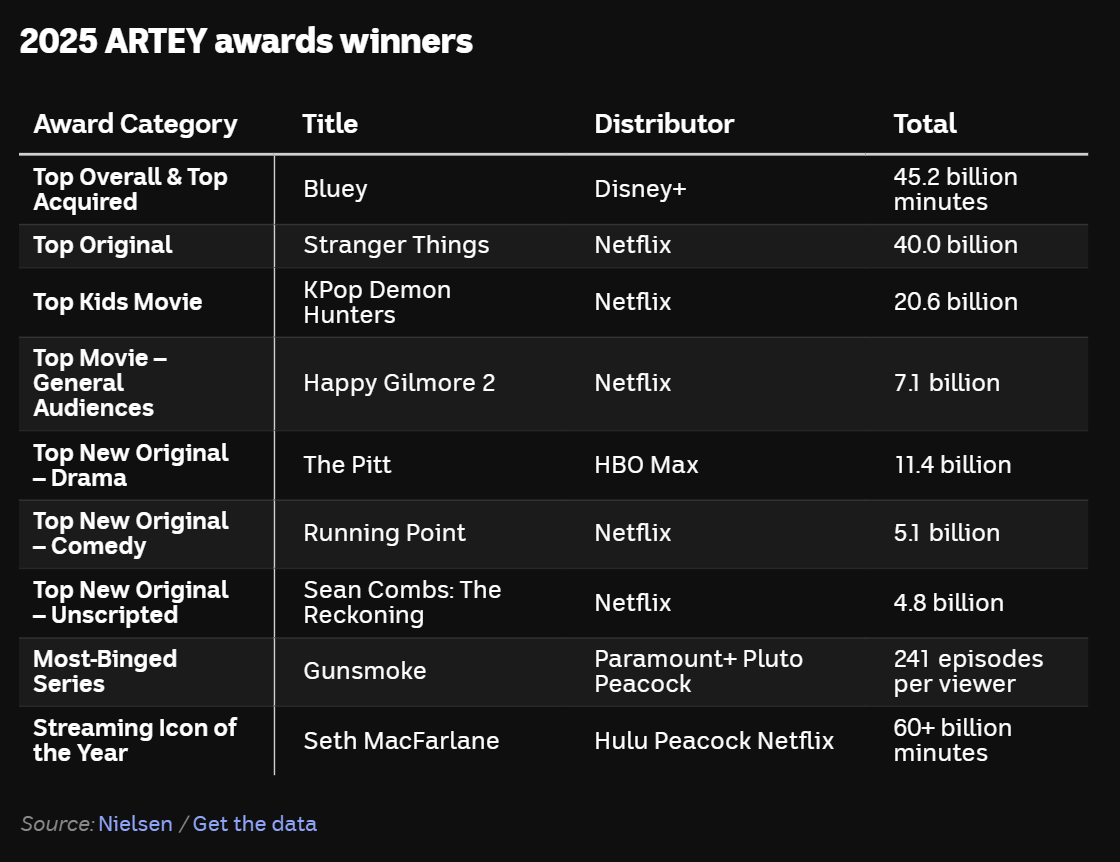
Bluey was the most-streamed title of any genre, on any platform in the United States in 2025 with 45 billion minutes watched, per Nielsen. This was the second consecutive year at No. 1. Out of the 154 total episodes released across three series, 153 are approximately 7 to 9 minutes long, while only one episode ("The Sign") exceeds the 10-minute mark meaning that approximately 99.4% of Bluey episodes are less than 10 minutes long
That number belongs in a conversation about platform-level attention concentration, not just children's programming.
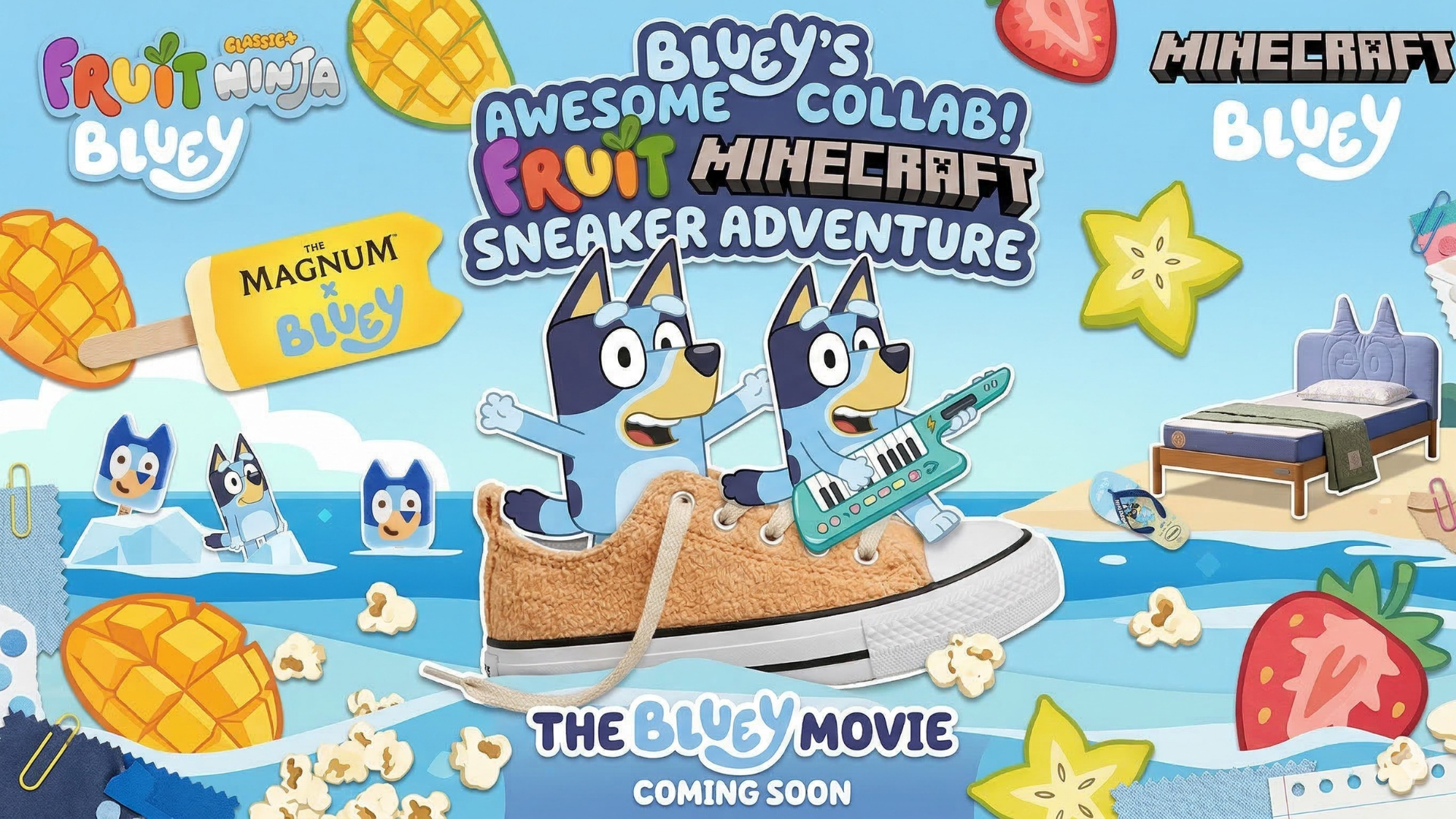
BBC Studios generated record £2.16 billion in commercial sales last year ($2.8 billion USD), with Bluey driving a significant share of the company's $3.6 billion in global retail revenue. LEGO sets. Disney Parks integrations. Kellogg's cereal boxes. Colgate toothpaste. Crocs. Converse.
All licensing revenue that BBC Studios captures directly.
Now look at where those 45 billion minutes are actually watched. Disney+. Disney Junior. YouTube. Every minute of ad-supported Bluey viewing flows through someone else's ad stack.
Four New Bluey Series Just Launched. Every One Monetized by Someone Else.
BBC Studios launched four new Bluey short-form series last year — Bluey Tunes, Bluey Puppets, Bluey Cookalongs, Bluey Fancy Restaurant. They're co-commissioned across ABC Australia, Disney Junior, Disney Channel, Disney+ globally and the official Bluey YouTube channel, which carries 10 million subscribers and 7.5 billion lifetime views.
Notice something? Every single outlet is a platform BBC Studios doesn't control the ad sales for.
This matters because short-form is exactly where streaming ad inventory is headed. Disney+ launched Verts — a swipeable vertical video feed on mobile — and is already signaling plans for creator content and new formats inside it. Netflix confirmed vertical video will anchor a full mobile redesign. Peacock and Tubi have their own versions too and it's not a trend, it's the literal next step for streaming apps.
Daily mobile engagement changes the economics of streaming. Bluey short-form content is purpose-built for that very behavior.
The question then is 'who captures the ad value when it lands inside those feeds?'.

BBC's U.S. Ad Sales Pitch Doesn't Mention Its Most-Watched Property
While Bluey dominates streaming viewership, BBC Studios' own North American ad sales pitch is built around something else entirely.
Jon Otto, Senior Vice President of Ad Sales for BBC Studios in North America, told AdExchanger this week that his strategy centers on bbc.com — news, F1 coverage, Planet Earth and what he calls the "habitual audience" of U.S. visitors. That habitual audience equating to roughly 7% to 8% of monthly visitors consuming 35 to 40 page views per month.
Bluey doesn't appear in the pitch.
That might be the correct organizational design. BBC Studios' web properties serve a fundamentally different audience than the families streaming Bluey on Disney+. But it means the company running the most-watched IP in America has structurally separated its ad sales operation from the content generating the most attention.
For anyone evaluating BBC Studios as a cross-portfolio advertising partner, that's the first question to resolve: Are you buying access to the bbc.com audience graph, or are you buying proximity to the BBC Studios IP portfolio? Right now, those are two different transactions with two different counterparties.
$3.6 Billion in Retail Without Touching an Ad Server
BBC Studios' Bluey strategy arguably represents the most effective IP monetization engine in children's entertainment.
Suzy Raia, EVP Global Products at BBC Studios, has been explicit about the long-term vision: build Bluey into a "generation-defining brand" that spans preschool, family and adult lifestyle categories over a 25- to 75-year horizon. The licensing roster reflects that ambition — LEGO, Little Tikes, General Mills, Bush's Beans, Converse, Disney Parks, Funko — and the upcoming 2027 theatrical film under the Disney banner will accelerate it.
The commercial logic is clear. Licensing revenue is high-margin, directly captured and doesn't require BBC Studios to build ad tech infrastructure or compete for programmatic dollars. No measurement stack. No first-party data platform. Great IP, selective partnerships and distribution reach — all of which BBC Studios has.
If you're thinking about the vertical video inventory thesis: Bluey short-form content is already formatted for the mobile-first feeds every major streamer is building. That inventory will be monetized by the platform, not the IP owner. As vertical video scales, platform leverage over content owners increases — even content owners sitting on the most-watched property in streaming. What does that imply for CPMs on short-form versus long-form inside the same app?
If you're modeling the economics of IP ownership versus distribution: BBC Studios chose licensing over ad tech. That decision lets Disney, YouTube and the DSPs own the audience data, the targeting graph and the advertiser relationship for Bluey viewers. BBC Studios gets predictable licensing fees instead.
Apps, Infrastructure, and Content
BBC Studios doesn't need to close the measurement gap if Disney and YouTube are closing it for them. They don't need a first-party ad data platform if the licensing revenue model keeps compounding. The current structure — own the IP, let partners monetize the audience — has generated billions and will continue to.
But as vertical video inventory scales inside streaming apps, the ad value of short-form premium content will grow. And the entity that controls the ad stack will capture that value, not the entity that created the content.
BBC Studios has the most-watched IP in streaming, a short-form content library purpose-built for the format every platform is adopting and no direct mechanism to monetize the ad side of either.
The answer depends on whether you think the future of streaming economics favors the IP owner or the platform operator.
Right now, the streaming apps are building the infrastructure to find out.
This Article By the Numbers
Get the SOS. Brief
The sharpest streaming intelligence, delivered to your inbox.