NEW PODCAST: Are You Really Reaching New People? MRI-Simmons' Emily Williams Says 'Probably Not'
Every media plan starts with the same assumption: add another platform and you've reached another audience. Layer streaming on top of linear, and you've expanded your reach, right? Maybe not.
MRI-Simmons is one of the largest consumer research companies in the US, built on address-based probabilistic sampling — real, randomly selected households, not an opt-in panel. That's the foundation for four key findings from today's conversation that should change how you plan, buy, or sell media.
Meet Emily Williams, Consumer Expert at MRI-Simmons. Emily has the data to tell you that's probably not true — and today she breaks down five key insights:
1. Your linear and streaming buys are probably hitting the same people 📺
MRI-Simmons' syndicated Cord Evolution Study found that 75% of people who still pay for cable or satellite TV also stream.
Three out of four cable subscribers are stackers, not switchers.
That means before assuming a streaming buy adds incremental reach to an existing linear plan, check for household overlap first or consider how to solve for overlap if using multiple demand-side platforms (DSPs) like Amazon DSP and Google's DV360. The default assumption should be duplicated reach versus incrementally new audiences.
2. How many apps?! 🤯
The average American uses 11 different streaming services a year — essentially a new subscription every month. It sounds like a wide-open audience. The data says the opposite: with churn that high, people are cycling through the same pool of platforms, not expanding into new ones.
Stop asking "which apps should I buy?" Start asking "who am I actually trying to reach, and where are they already being reached?" Another app, platform, or otherwise on a five-platform plan is likely more overlap than expansion.
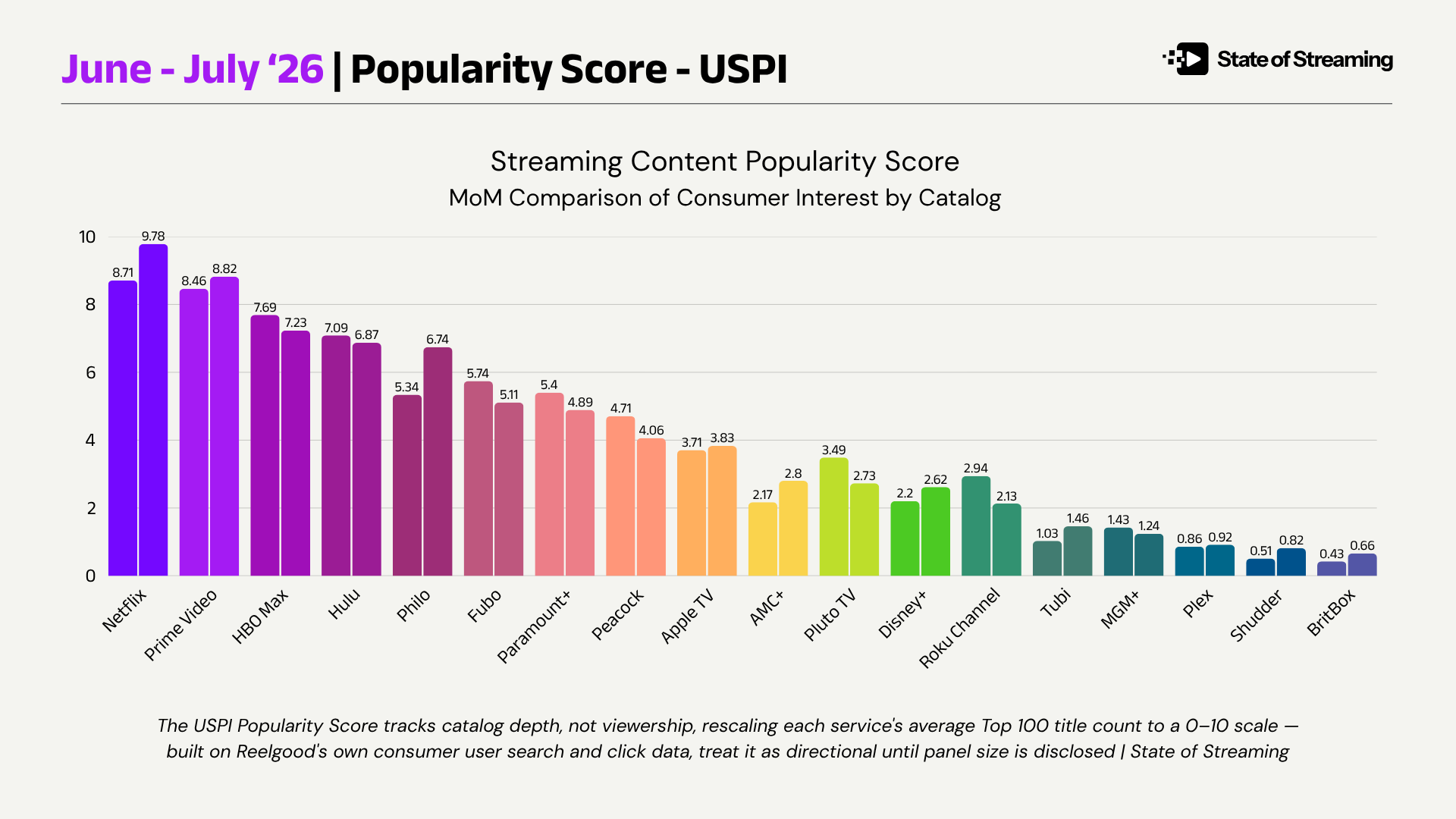
We've started tracking that movement of interest between apps in our monthly Unified Streaming Power Index. We call it 'Popularity Score' and you can read about that here.
3. Minutes viewed is not the same as attention ⌛
MRI-Simmons' core USA Study found 63% of adults say they're usually doing something else while watching TV — cooking, cleaning, scrolling. A campaign generating 100 million minutes watched among people with zero category interest will always outscore a 20-million-minute campaign among high-value prospects on a dashboard — even though the second one is doing the real job.
While you're listening to the podcast, you may want to scroll Michael Beach's piece: The Real Cost of Screens where he does the math on exactly that.

Never report minutes viewed without pairing it against audience quality. Ask who you reached and why they mattered before celebrating the number.
4. Platform-siloed planning hides your best audiences 🫣
Emily shares an interesting unified audience data point:
90% of Instagram users shop on Amazon, 50% of Amazon shoppers watch Hulu, 50% of Instagram users are booking international travel this year, 50% of Hulu viewers are in-market for a car right now.
None of that shows up if you plan by channel instead of by person.
Instead build audience segments around behavior and intent, not platform. The overlap between "my Instagram audience" and "my Hulu audience" is often the highest-value segment you have — and it's invisible until you look for it.
Bonus: A 3-Year Prediction
Williams submits that the industry will look back and realize it confused more choice with a better experience — 40% of adults already feel overwhelmed by streaming options, and MRI-Simmons tracks 170+ FAST channels alone, a list that continues to grow. Emily's case?
Fragmentation was never a measurement problem, it was a consumer experience problem.
If any of these four points changes how you'd build your next plan, the full conversation goes much deeper on the data behind each one — including the what stats to bring into your next planning or client meeting.
📺 Watch or 🎧 Listen to the full episode here: https://podcast.stateofstreaming.com/mri-simmons-emily-williams-q2-2026/
Get the SOS. Brief
The sharpest streaming intelligence, delivered to your inbox.