Netflix and YouTube Are Paying ESPN's Debt Service
Key Takeaways
ESPN returned Monday Night Football inventory not because it lost a bidding war, but because it calculated NFL Network's RedZone and subscriber data were worth more than doubleheader games it couldn't monetize efficiently behind a paywall — and then let Netflix and YouTube set the market price by accepting them.
Netflix and YouTube are paying clearinghouse-rate premiums for NFL adjacency on inventory ESPN strategically devalued — if those per-game fees cover ESPN's acquisition debt service, the streamers are functionally financing ESPN's NFL Network purchase.
The NFL enters 2028 broadcast rights negotiations having collected equity from ESPN, rights fees from Netflix and YouTube, and a room full of platforms that have all proven they will pay for NFL inventory at any tier.
Netflix and YouTube Are Paying ESPN's Debt Service
In professional sports, a team can trade a player, collect draft picks in return, and still retain a percentage of that player's future earnings. The acquiring team pays the salary. The original team keeps the upside.
ESPN just ran that play on the NFL rights market.
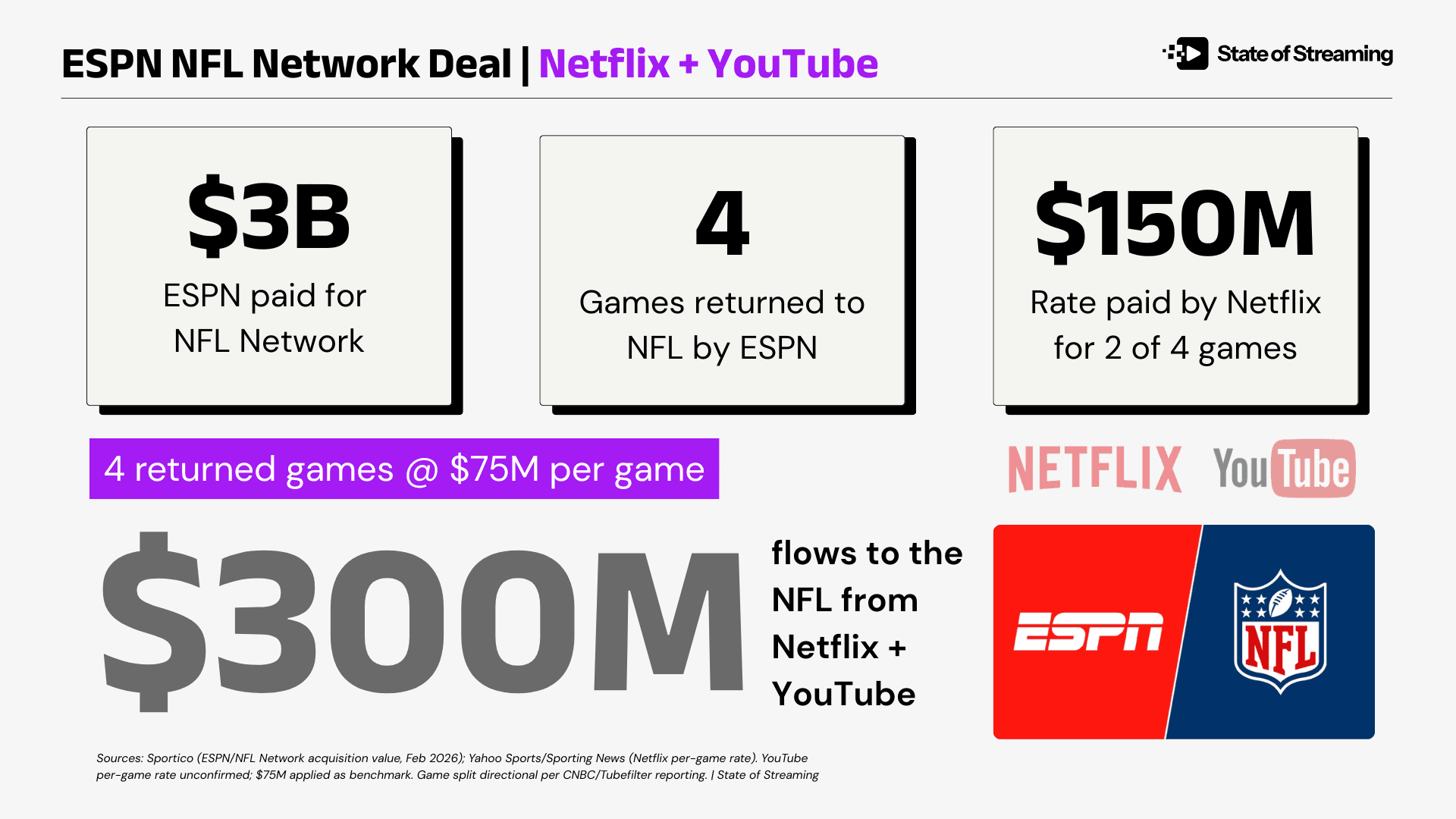
ESPN paid $3 billion for NFL Network. The four Monday Night Football doubleheader broadcasts it surrendered were a direct condition of that acquisition — two going to Netflix, two to YouTube. Netflix pays approximately $75 million per game for NFL rights — the rate established through its Christmas Day deal and the most reliable public benchmark available.
At that rate, the four returned games represent roughly $300 million in rights fees flowing directly to the NFL. That is 10% of ESPN's $3 billion acquisition cost, paid not by ESPN, but by the two streamers absorbing inventory ESPN calculated wasn't worth keeping.
What ESPN Actually Did
The Monday Night Football doubleheaders splitting between Netflix and YouTube were not surrendered under competitive pressure. They were the inventory ESPN returned after calculating that NFL Network's owned infrastructure was worth more than a doubleheader package it couldn't price efficiently behind ESPN Unlimited's paywall.
Think of it this way: ESPN now controls the most valuable layer of NFL media distribution. Returning two doubleheader games is the price of owning the building while subletting the floors ESPN didn't need to Netflix and YouTube.
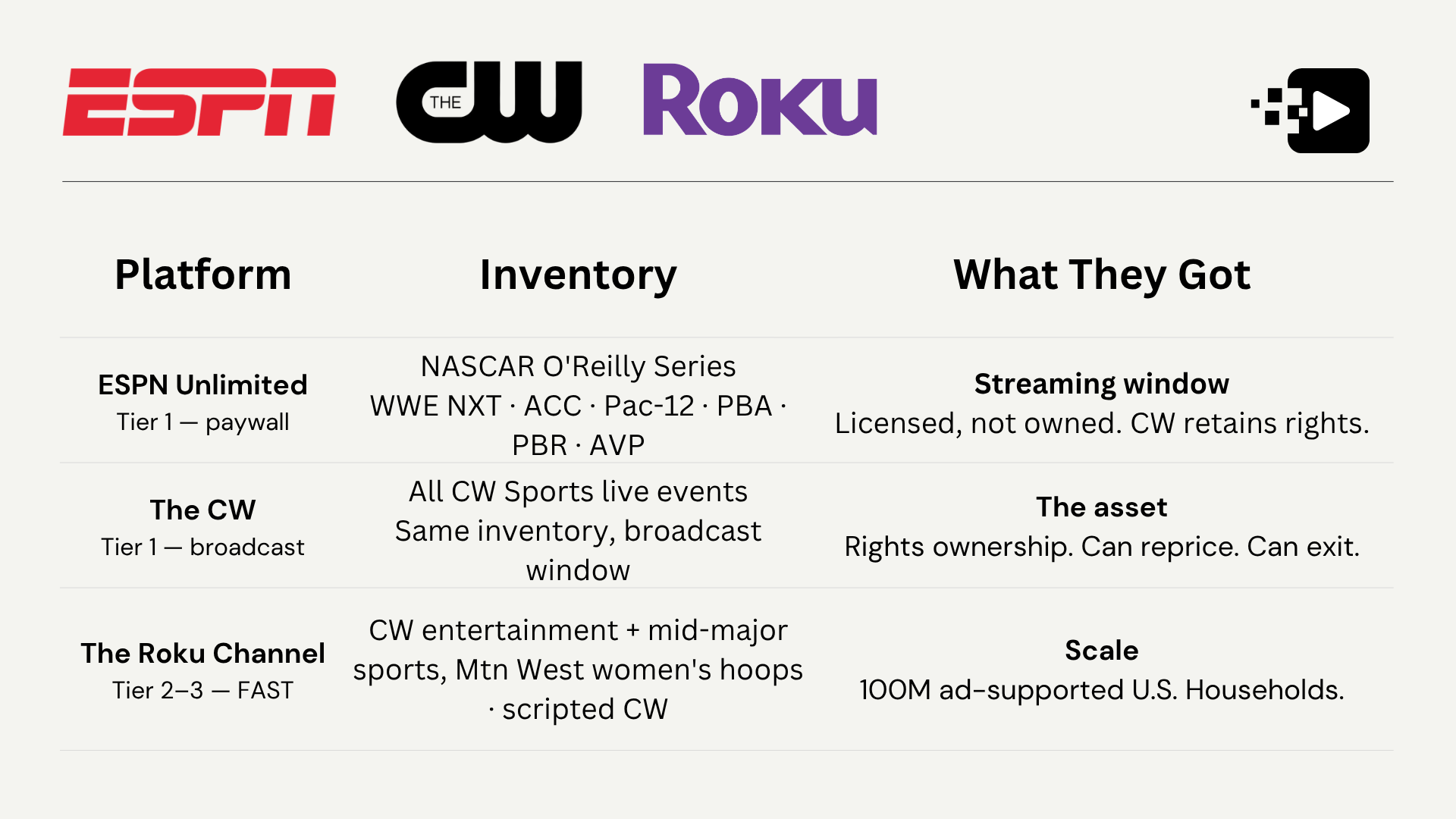
The CW licensing deal used the same framework at smaller scale. ESPN takes the inventory tier it can price at a premium, licenses or returns what it cannot, and uses the brand halo of the retained asset to justify the paywall cost to subscribers. The Monday Night Football doubleheaders are the CW's third-tier NASCAR races at NFL scale.
What Netflix and YouTube Are Actually Buying
Neither platform wants a full broadcast commitment. Netflix runs a Christmas Day doubleheader. YouTube carries overflow inventory. Both want the NFL logo attached to a high-CPM night without the operational complexity of a full broadcast season.
The games ESPN returned are not the NFL's best inventory. They are the NFL brand on nights ESPN determined wasn't worth defending. Netflix and YouTube are paying a premium for the association — adjacency to a rights portfolio that ESPN now controls more completely than at any point in its history.
What Media Buyers Should Do With This
The clearinghouse model changes three things about how buyers should build NFL plans right now.
#1 Map the tier before pricing the buy
NFL inventory is no longer a single asset class. A viewer watching RedZone through ESPN Unlimited is a different audience composition than a viewer watching a Monday Night Football doubleheader on Netflix or a YouTube overflow game. Each tier carries different reach guarantees, different CPM floors, and different demographics. A media plan that treats all three as interchangeable NFL inventory will misprice at least two of them.
#2 Model the 2028 opt-out into every multi-year commitment
Everyone writing a check for NFL inventory in 2026 returns to the negotiating table in two years as a proven bidder. Current rates on Netflix and YouTube NFL inventory will not hold once the opt-out triggers and the bidding war restarts. Build the exit assumption into the plan now, not in 2027 when the repricing is already happening.
#3 Follow the rights structure, not the brand
ESPN Unlimited subscribers are buying access to inventory ESPN owns outright. Netflix and YouTube viewers are watching inventory ESPN returned under a structure the league controls. Those are different floor guarantees for an advertiser. The NFL logo appears on all of it. The contractual architecture underneath is not the same product.
ESPN did not lose Monday Night Football. Rather it returned the inventory it no longer needed, at a market rate Netflix and YouTube established by accepting it. The NFL made sure they got paid by everyone in the room.
Buyers who read this as a distribution story will optimize against the wrong variable. The rights architecture underneath Monday Night Football just changed and the CPM conversation needs to catch up.
Get the SOS. Brief
The sharpest streaming intelligence, delivered to your inbox.