Why Paramount Hired Two Streaming Executives to Run a Broadcast Business
Approximately 27% of Paramount's revenue depends on ad sales. TV advertising fell 10% in the fourth quarter of 2025. Askinasi's mandate is not to defend that number. It is to replace the logic underneath it.
Jay Askinasi spent years on the buy side at Publicis before moving to Roku, where he led the argument that streaming inventory should be bought, priced, and measured like digital. "As we progress," he told the Marketecture podcast in August 2024, "it will continue to look more like digital than linear." Six months later, Paramount hired him as Chief Revenue Officer. His first external hire was Danielle Carney, who ran sports ad sales at Amazon Prime Video.
The Product Is the Argument
The "streaming fixed unit" Askinasi is now selling at Paramount — a guaranteed premium position for the first seven days after a new episode debuts — is not a product innovation. It is a buy-side objection packaged as a publisher solution. Askinasi knows the objection because he raised it. As a Publicis buyer, he watched brand advertisers resist programmatic because it stripped the one thing linear always delivered: predictability. A guaranteed first position in a commercial break, tied to a specific piece of content, in a specific launch window, is the answer to that objection. He built the argument at Roku. Now he is selling it at Paramount.
The practitioners are reaching the same conclusion independently. Jean Carucci, the Streaming Strategy Scholar built go-to-market frameworks at Discovery and Warner Brothers Discovery, describes prime pod placement in direct terms on the State of Streaming podcast: "I'm the very first ad you see in that first ad break — really, really valuable... people remember that." Carucci identifies it as one of three streaming ad formats gaining the most momentum in 2026. Askinasi is packaging that momentum as Paramount's flagship upfront product.
The Pattern Is Bigger Than Paramount
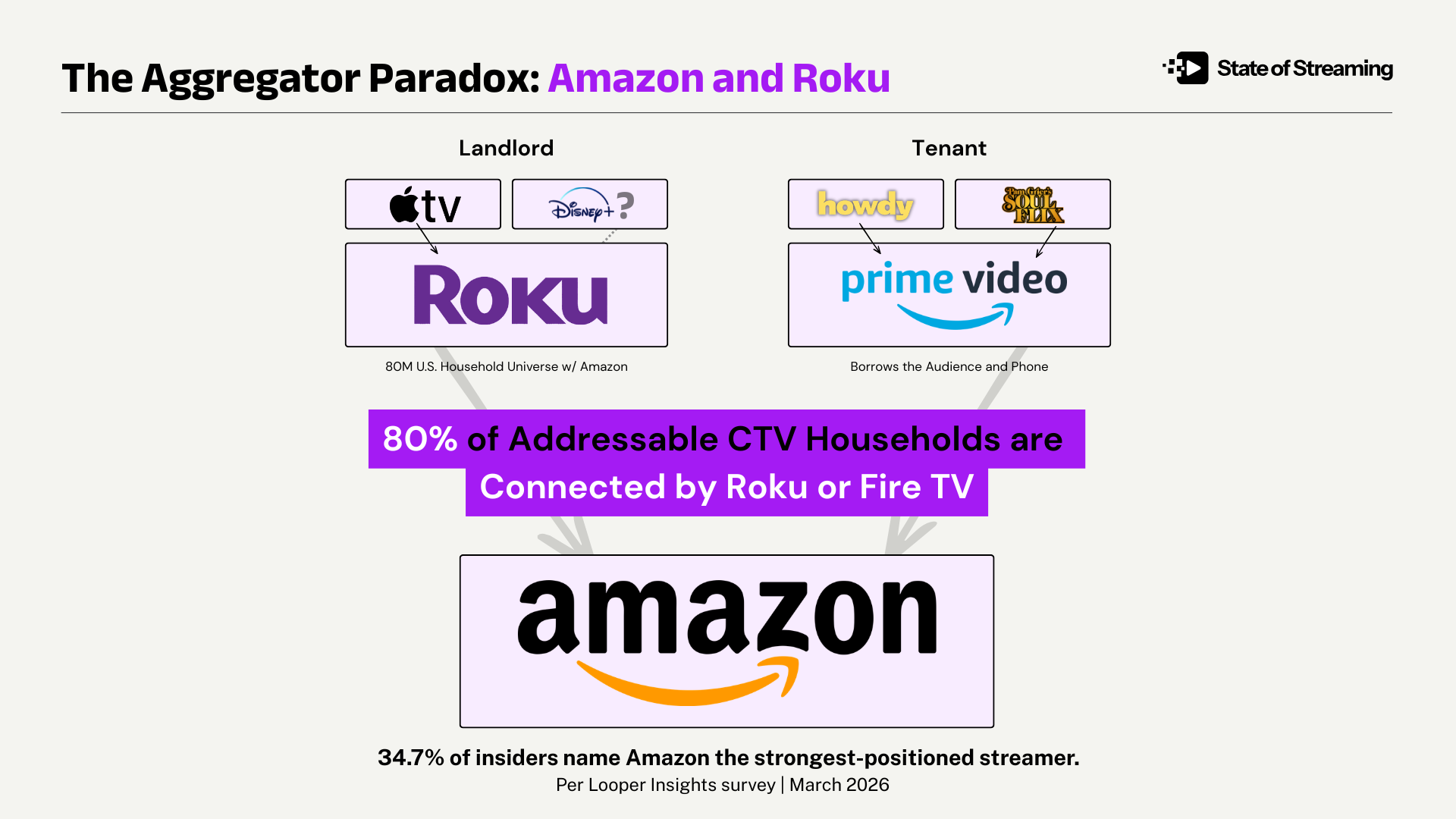
Charter reversed subscriber churn for the first time by absorbing streaming services into the cable bundle rather than competing with them. Versant landed a free FAST channel and a paid subscription tier on Prime Video the same week, using Amazon's distribution infrastructure as the pipe for both. Scripps built a women's sports network inside FAST infrastructure, monetizing rights it already held through a new delivery layer.
The boundary between linear and streaming is no longer being negotiated at the content level. It is being dissolved at the transaction level.
Read The Aggregator Paradox Next
Get the SOS. Brief
The sharpest streaming intelligence, delivered to your inbox.