YouTube's Ad Pause Is A Data Collection Strategy.
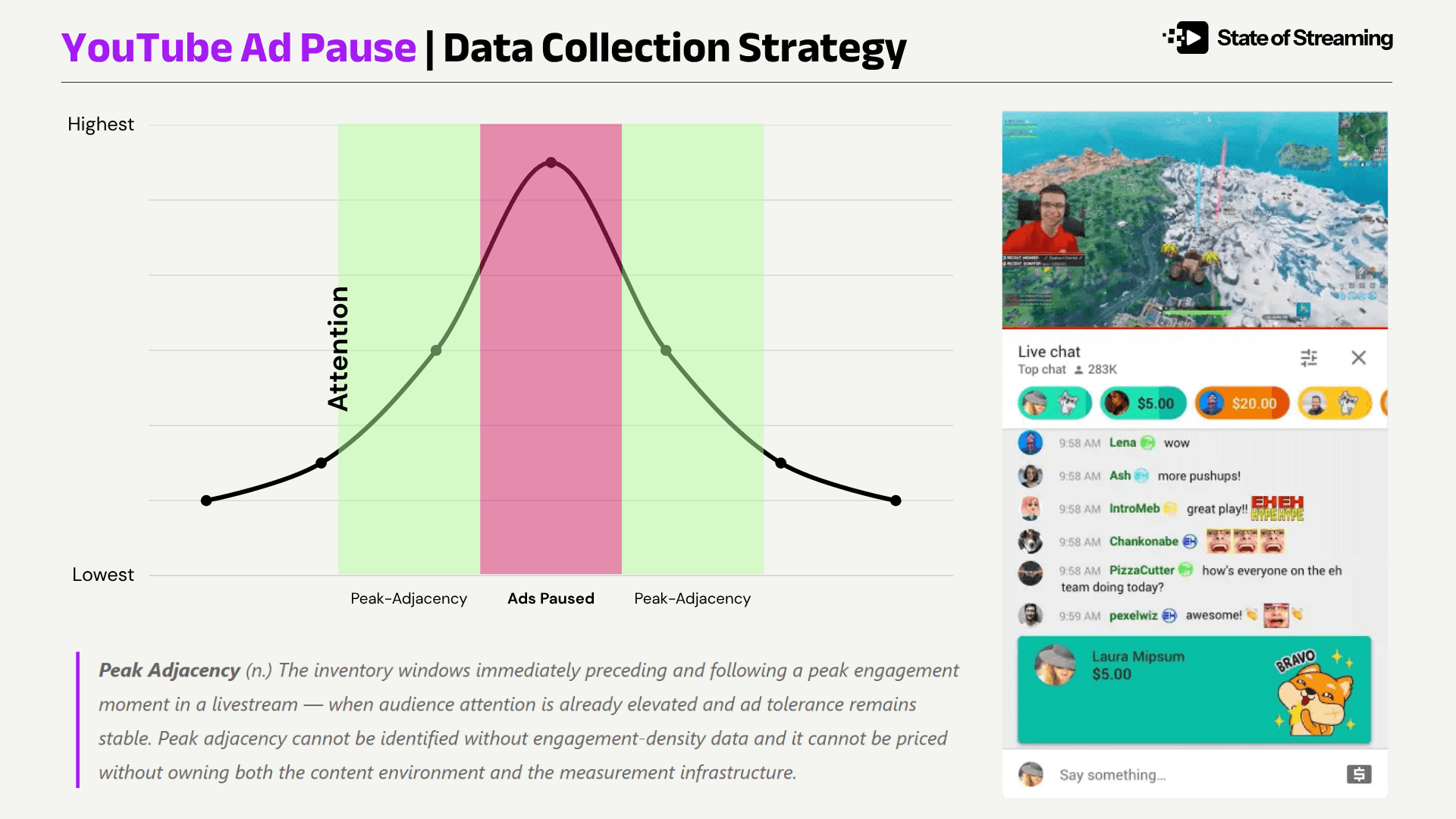
YouTube announced this week it will pause ad delivery during peak livestream engagement moments — when chat explodes with Super Chats, Super Stickers, and gifting activity — and let AI decide when the pause ends.
The short-term ad revenue sacrifice is real but the long-term audience insights are unique to YouTube's story.
Over millions of streams, across sports, gaming, music, and creator content, that dataset becomes a granular model of audience attention over time. Not just whether someone was watching — but when they were most activated, and what the seconds immediately before and after that activation looked like.
That is an inventory category that does not yet have a name. Here at State of Streaming, we are calling it Peak Adjacency. This is how we define it:
Peak Adjacency (n.) The inventory windows immediately preceding and following a peak engagement moment in a livestream — when audience attention is already elevated and ad tolerance remains stable. Peak adjacency cannot be identified without engagement-density data and it cannot be priced without owning both the content environment and the measurement infrastructure.
The moment before the chat explodes is when attention is already climbing but ad tolerance hasn't collapsed. The cooldown after is when viewers are still present, still elevated, and ready to re-engage. Both windows are more valuable than the average mid-roll. Neither is currently priced that way — because until now, no one had the data to identify them at scale. Now YouTube will.
This is the compounding dynamic we've tracked across YouTube's expansion. Out of every sixty minutes of video content watched on a living room television, YouTube commands seven and a half minutes out of every hour — a share built on passive viewership that its own job postings suggest it knows isn't fully monetized. It signed a preferred platform deal with FIFA for the 2026 World Cup, the single largest simultaneous livestream event in the history of the medium. It is actively building youth audiences through MLB Clubhouse before those viewers are old enough to buy Super Chats. Each move expands the engagement surface and the ad pause expands the measurement depth.
There is also a regulatory layer worth watching. A Los Angeles jury found YouTube liable as a streaming platform in March for addictive design mechanics. Autoplay, algorithmic recommendations, notification systems — the exact infrastructure YouTube uses to drive the engagement density it is now teaching its AI to read. If court orders or settlement terms eventually mandate changes to those mechanics, the engagement-density dataset YouTube is building today becomes the hedge: a way to extract premium value from the attention it can still capture even under a constrained product surface.
The ad pause only works when creators have automatic ads enabled. That is not a footnote. It means YouTube is structuring the deal so that the creators who opt in are the ones generating the training data. The more creators participate, the richer the model. The richer the model, the more YouTube can eventually charge for the windows around the peak — windows it will control and creators will not. As State of Streaming has covered, the creator relationship with YouTube's monetization infrastructure has never been symmetric. Creators opt in. YouTube compounds.
This is what $40.4 billion in annual ad revenue buys that no other platform can afford: the patience to sacrifice today's revenue for tomorrow's pricing architecture.
Pausing the ad is the product flex.
The data is the long-term asset.
Get the SOS. Brief
The sharpest streaming intelligence, delivered to your inbox.