Go Addressable Turns IP Targeting's Failure Into an Deterministic Upfront Super Power
Key Takeaways
IP-to-postal address matching is accurate just 13% of the time, per CIMM and Go Addressable research — meaning most open-internet CTV targeting is operating on a structurally broken signal.
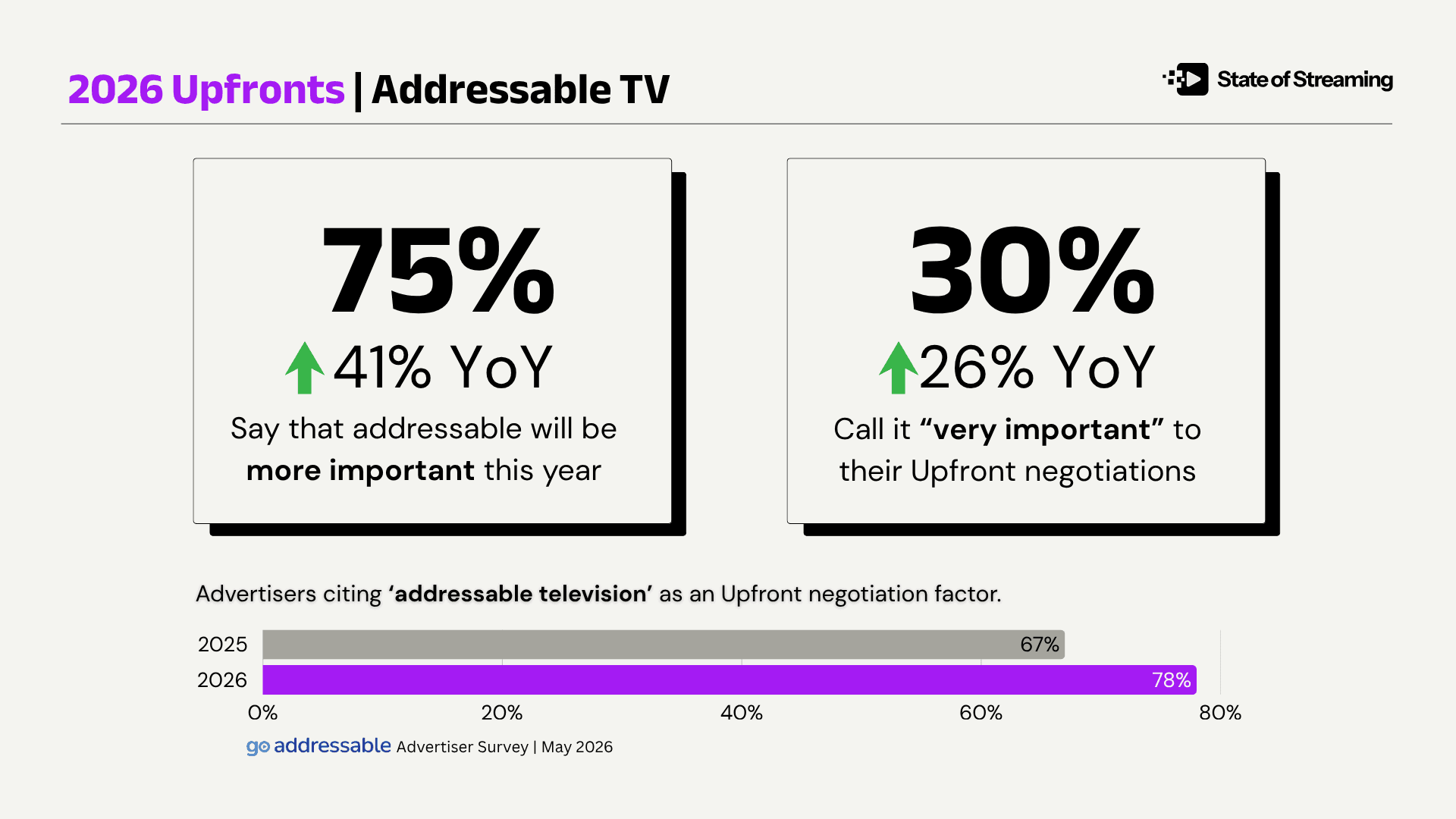
The 11-point rise in advertisers citing addressable TV as an Upfront factor (67% to 78%) is not momentum; it is documented leverage, driven by data buyers now hold at the negotiating table.
Go Addressable is the open internet's only organized institutional response to an identity problem the walled gardens solved for themselves years ago.
Google knows who you are. Amazon knows what you bought. Meta knows who you told about it. Their ad targeting runs on deterministic identity: authenticated logins, first-party purchase data, verified household signals. They do not rely on IP addresses. The rest of the television advertising ecosystem does. And the data on what that costs is now in the public record.
What's wrong with IP-to-postal address matching?
A study commissioned by the Coalition for Innovative Media Measurement (CIMM) and Go Addressable, conducted by data-validation firm Truthset against nearly one billion IP records, found that IP-to-postal address matches are accurate 13% of the time. IP-to-email matches land at 16%. The six major data providers tested agreed on the same IP-to-postal linkage just 6.4% of the time. Billions of dollars in connected television (CTV) targeting are trading on a signal that is wrong more than eight times out of ten.
What advertisers want...
Seventy-eight percent of advertisers now say addressable TV will factor into their 2026 Upfront negotiations, up from 67% the year prior. That 11-point jump did not come from enthusiasm. It came from leverage. New research released today by Go Addressable and Advertiser Perceptions sharpens the picture further: among those buyers, 75% say addressable TV will be more important in 2026 than it was in 2025, a 41% increase year over year.
Nearly 30% call it "very important" to their negotiations, up 26% from last year. Buyers have peer-reviewed documentation that the identifier underpinning most open-internet CTV targeting is structurally unreliable. Deterministic identity is no longer a premium add-on request. It is the ask — and the walled gardens started building that standard a decade ago.
How can Go Addressable help?
Go Addressable is the industry's only organized response to that gap. The trade organization, founded by AMC Networks, Comcast Advertising, DIRECTV Advertising, DISH Media, and Spectrum Reach, operates on three pillars: simplify the understanding of deterministic targeting workflows, socialize best practices through research, events, and community, and scale addressable advertising to an end state that does not require compromise between identity quality and reach. The goal being structural parity with ecosystems that never had to compromise in the first place.
What's in the course?
The curriculum reflects that ambition. More than 1,000 media professionals completed the entry-level Addressable Essentials course since its launch earlier this year. The Addressable Master module, focused on cross-platform planning and measurement strategy, is now live on Substack. Addressable Pro arrives in the second half of 2026.
Five new members joined at the organization's annual Upfronts brunch today:
DoubleVerify
Mastercard
OpenAP
Philo
Veeva Crossix
That roster now spans verification, financial services, identity infrastructure, distribution, and pharmaceutical data. That is validation of a supply chain assembling around a shared structural problem.
Moving Forward
The walled gardens are not opening their identity infrastructure. The open internet has to build its own, or continue trading on a signal that is accurate 13% of the time and calling it IP targeting. Go Addressable is the coalition making that build executable.
Watch This
Next In Media: Mike Law, CEO of Carat North America on Why Addressable TV Needs Deterministic Identity to Deliver
Get the SOS. Brief
The sharpest streaming intelligence, delivered to your inbox.