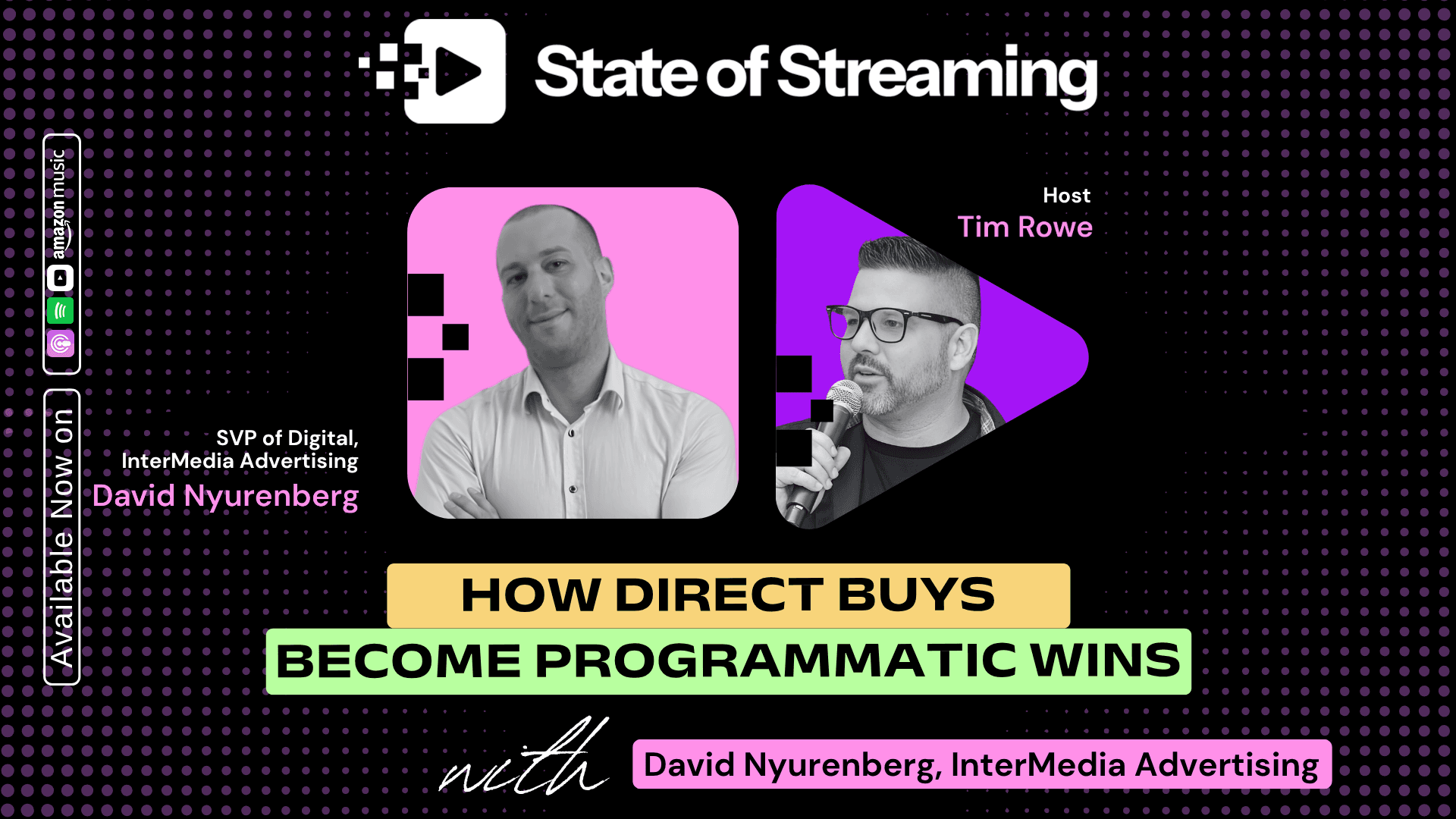
Unlocking CTV’s Black Box: An interview with David Nyurenberg, SVP Digital at InterMedia Advertising
How can you drive performance if you can't understand the content that drives performance and then buy more of that? - David Nyurenberg
In today's conversation, I sat down with David Nyurenberg, SVP of Digital at InterMedia Advertising. David takes us behind the scenes of three CTV projects that are finalist nominations at the upcoming AdExchanger awards at Programmatic IO next Monday, September 28th in New York City. We discuss how closing the conversion loop with publishers like Tubi, NBCU, and Paramount turns direct buys into top-performing tactics. We also discuss how to pull off show-level targeting on streaming without violating privacy, and why advertising against positive local news is great for your bottom line.
How Do We Close the Loop?
Tim Rowe: Let's talk about the first project which was direct publisher conversion optimization. You worked with Tubi, NBCU and Paramount on this project. What was the problem and what were you trying to solve?
David Nyurenberg: In the CTV space, there are multiple ways to buy inventory. Obviously, you could buy programmatically through a DSP, and you could buy direct to publisher. More advertisers are buying direct to pub for a variety of different reasons. One is efficiency —you get better rates when you go directly to the publisher and you're able to cut out middleman fees and tech fees.
The challenge with direct buys is that programmatic offers an advantage on the measurement and optimization side of things. Typically, measurement is owned by the brand or the client, and the publisher has no visibility into what works from a conversion perspective, or what slices of their inventory are actually driving performance. They don't have any of those inputs, so they can't optimize the media buys. Those direct buys are what I call "dumb buys". They either work or they don't. It's a roll of the dice.
The challenge here was how do we close the loop? That was the name of the case study, Closing The Loop. How do we close the loop from the publisher side so that the publishers can actually measure performance against their media and then optimize their media directly without the need of an intermediary layer?
Tim Rowe: What was the workflow like for executing this?
David Nyurenberg: The scope of implementation is not that complicated. They (publishers) all have their own pixels. They place pixels on the site and they're able to tie their media against the pixel-based measurement. And that's really that. But the great cherry on top of all this was on a really big buy for a really big client with pretty much every single major publisher running, those three publisher tactics were the best performing tactics from a performance perspective across the entire buy.
Privacy Safe Show Buying
Tim Rowe: Let's talk about the second project which addressed privacy-safe show buying and optimization with Peer39 and Pontiac Intelligence. A finalist for Most Innovative use of CTV Technology and Most Innovative Marketing Campaign. Tell us about this one.
David Nyurenberg: This is a project I'm very proud of because I've been banging the drum about show-level transparency for years now. I believe the lack of show transparency holds our channel back from truly driving performance, because how can you drive performance if you can't understand the content that drives performance and then buy more of that? It's been a big gap.
The reason why the Peer39 work excites me so much is because it hits scale. It relies on Peer39's content ID, which they integrate directly with publishers and assign their unique content ID to the publisher's shows. That's something they do as a service. I saw a use case for it where if we could just tie the random ID to outcomes, then we at least have a conversion signal to optimize. We don't know the name of the show because it's just a random ID. But I'm willing to give that up. I'm willing to give up the name of the show if I could at least have an identifier to tie conversions to that I could go after and buy more of to drive better performance.
Tim Rowe: So I may not know what I'm buying but I know the SKU of what I bought, for example, and I know it drives conversion, so let me buy more of it. Is that it?
David Nyurenberg: That's exactly it. In the performance game, we definitely care what we're buying and where we're delivering. But when it comes to the traditional reasons why people care, like brand safety, that's much less of a concern. If it's good inventory that's real and it converts, we're going to go after it and buy it because our job at the end of the day is to drive sales.
Good News is Good for Business
Tim Rowe: The last project, a finalist for Best Use of Technology by a Publisher or Media Seller. For this one you partnered with Spectrum Reach and Anoki AI. Good news is good for business. Tell us about that.
David Nyurenberg: It's always vexed me the way we treat news. In the performance space, as an agency, we buy tons of news. Our advertisers love news because it is efficient and it performs. People watching news tune in, and they typically tend to be older and have money.
But in this case, many advertisers still don't want to buy news, especially on CTV, because it's much harder to restrict it for brand safety. In a display online video world, you have keywords you could use to deduce brand safety. In CTV, you don't have that. It's all moving sound and image.
Enter Anoki and their AI technology. They're able to identify the context of what's on the screen. In this case, the implementation was, can we segment news into two categories? News that's more brand safe, positive stuff—like a Girl Scout cookie sale in your local neighborhood. And then, content that would be considered non-brand safe, like stories on wars, car wrecks, and negative stuff.
At the same time, we still wanted to buy the negative stuff. But we wanted to know which performs better. Does the positive news perform better or does the negative news perform better? We set up a scientific test, split everything evenly, and had a control line that was all news bundled together. Audiences were deduplicated. And sure enough, the good news outperformed both the everything line and the bad news line.
Want to watch or listen to the entire conversation?
Get it here: https://podcast.stateofstreaming.com/david-nyurenberg-intermedia-s5e5/
Get the SOS. Brief
The sharpest streaming intelligence, delivered to your inbox.