Here's a quick thought experiment before we get into it:
Imagine every TV, phone, and streaming device in America as a giant shopping mall. Some stores (that's Netflix, Disney+, ESPN) rent huge storefronts on the ground floor where everyone walks by. Others are stuck in a back hallway nobody visits. The store front you get — and how good it is — has almost nothing to do with how many people actually shop there as much as it's about the deal you cut with the mall's landlord.
That's basically what happened with the WNBA on Roku in Q2 and the numbers behind it are wild enough that they're worth breaking down.
There's a firm called Looper Insights that tracks a proprietary metric called $MPV — Media Placement Value. Here's what it does and does not measure:
It does not measure how many people watched a game.
It does not measure how much money a league made.
It does measure how visible a show, league, or team is on the home screens of a connected TV (CTV) home screen like — Roku, Apple TV, Fire TV, Samsung TVs, and so on.
That visibility (share-of-voice) gets converted into a dollar figure, to create a relative base to create comparable estimates across platforms.
So when you see a number like "$24 million in $MPV," the right way to read that is:
This league got roughly $24 million worth of prime visibility across streaming home screens this quarter.
It's a way of quantifying the value of attention.
Why should you care? Because in 2026, getting seen on the home screen before someone even presses play is becoming its own battleground — arguably as important as the broadcast deal itself and $MPV is a new way of quantifying who's winning that battle.
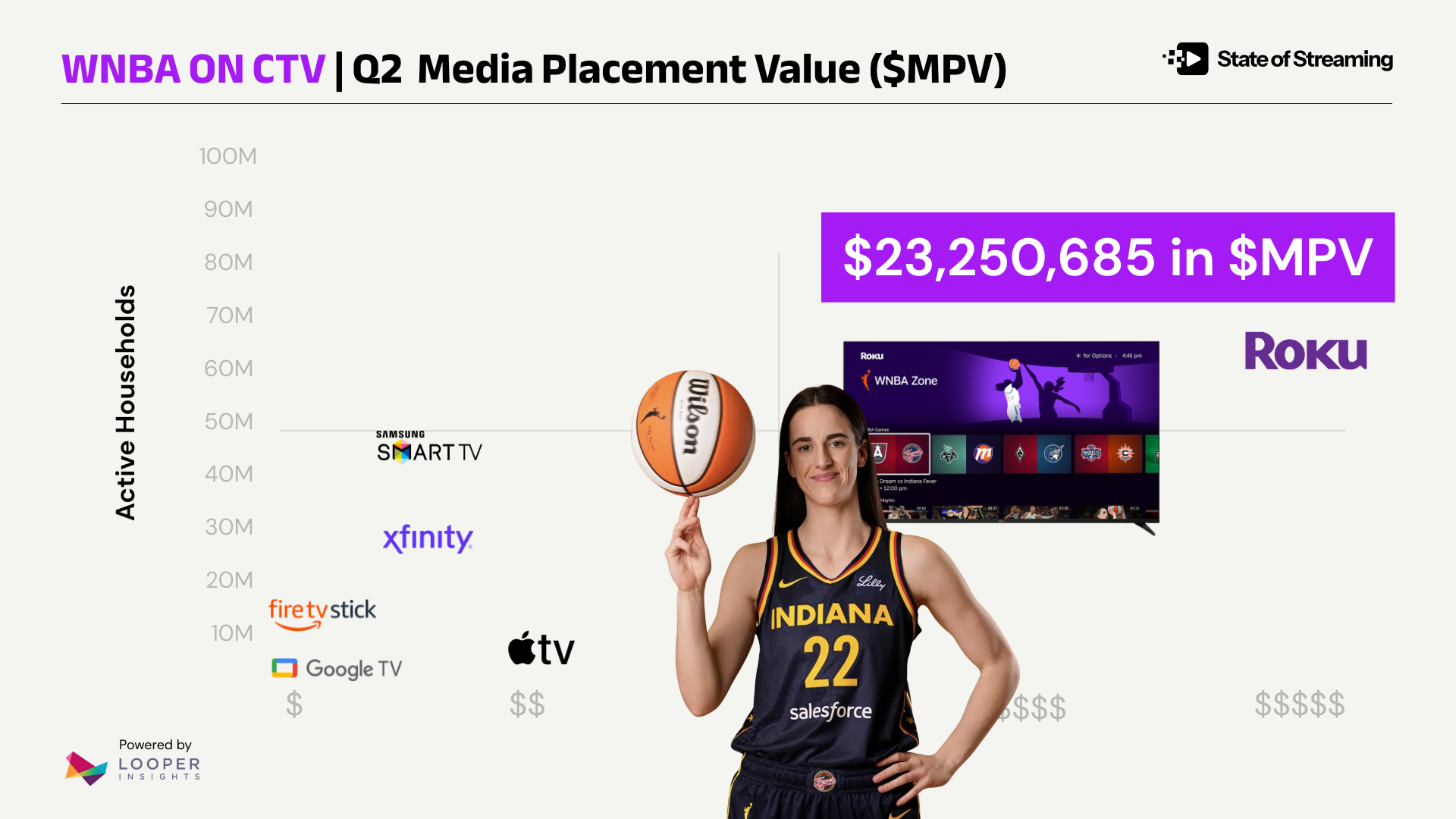
The WNBA posted $24.3 million in $MPV this past quarter — the third-highest total of any sports or entertainment title tracked, sports or otherwise. Impressive on its own. But look at where that visibility actually came from:
Roku: $23,250,685 (95.4%)
Apple TV: $513,715 (2.1%)
Xfinity: $297,184 (1.2%)
Samsung TV (2022): $170,906 (0.7%)
Fire TV: $76,660 (0.3%)
Samsung TV (2020): $52,526 (0.2%)
Google TV: $18,496 (0.1%)
Total: $24,380,172
Run that back.
One single platform accounts for basically the entire number. Not "Roku is the biggest piece." Roku is the number.
Roku built something called WNBA Zone — a dedicated hub inside the Roku home screen built just for the league. And it's worth understanding it's not just a folder of WNBA content. Open it up and you'll find:
Sponsor branding built directly into the hub (Salesforce)
Product placement front and center (a Wilson basketball, prominently featured)
A layout clearly designed to get you to stop, engage, and maybe subscribe — not just glance and scroll past
This isn't Roku's first rodeo with this playbook, either. It's the fourth women's sports hub Roku has built in the past 14 months:
NWSL Zone (March 2025)
Women's Sports Zone (March 2026)
March Madness Zone
WNBA Zone (this month)
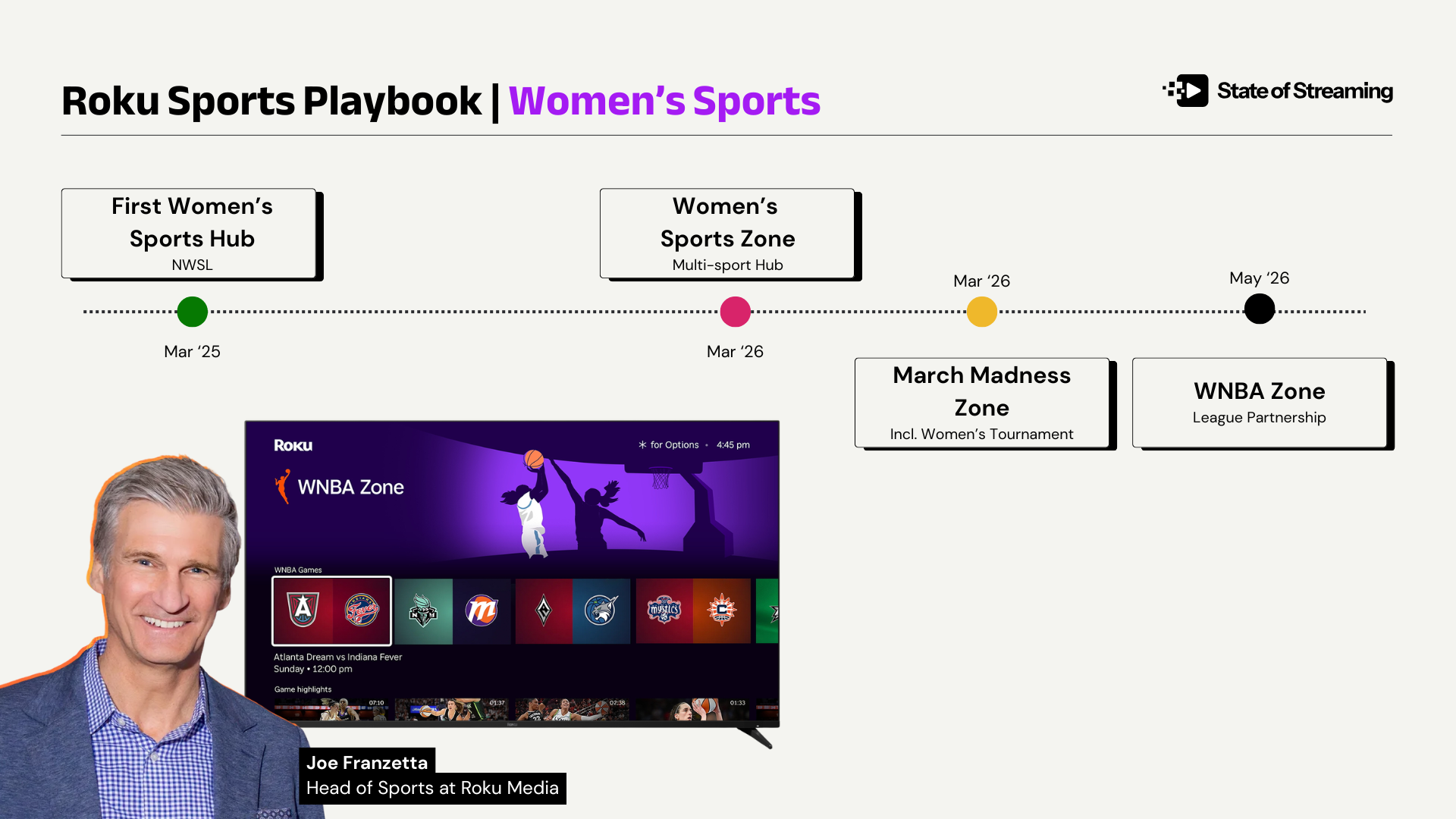
Same team building each one. Same strategy every time. We covered this playbook when the Zone first launched, and the underlying logic is simple:
Roku doesn't need to own a single second of WNBA broadcast rights to become the place fans go to watch it. It just needs to be the front door.
Fair question. We pulled Google search data — and our own viewership tracker — to check whether real fan interest backs this up.
The Google search data says the interest is real, and it's bigger than any one player:
Search interest in "WNBA" as a general term is running at an average of 51 (on Google's 0–100 popularity scale) over the past three months
Compared to searches for individual star players: Caitlin Clark sits at 14, Sophie Cunningham at 9, Angel Reese at 6
In other words, league-wide search interest is running 3 to 8 times higher than any single player by name
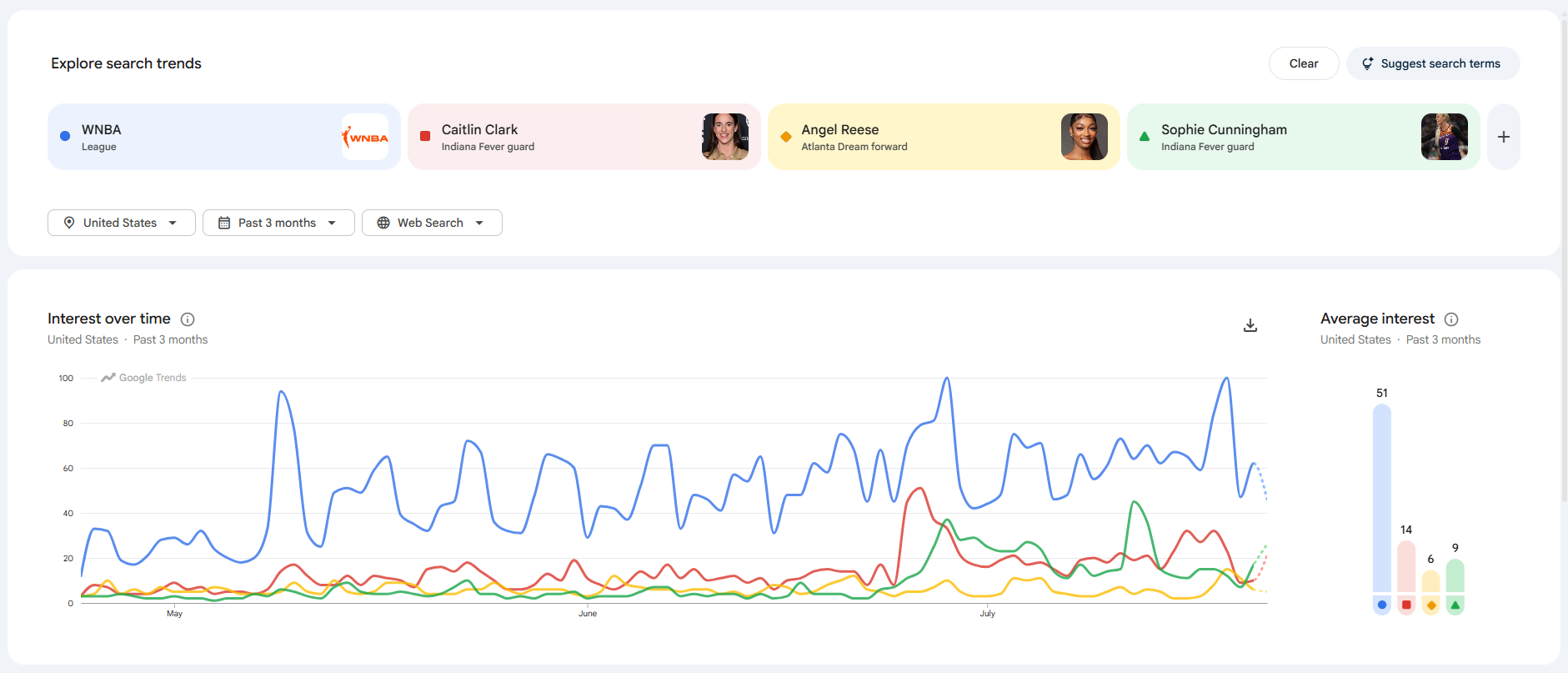
(Image courtesy of Google Trends as of 7/22/2026)
Here's why that matters: if this were really a "one superstar is carrying the league" story, you'd expect star-name searches to be exploding while the league name stayed flat. It's the opposite. This is the whole league growing organically. And that's exactly the kind of audience a league-wide hub is built to capture.
The actual viewership numbers back this up.
WNBA Draft 2026: 1.5M viewers (+20% YOY)
Preseason opener, Fever vs. Liberty: 0.74M (+76% YOY)
Regular Season Opener, Wings vs. Fever: 2.49M (+7.78% YOY)
Aces vs. Sparks: 0.53M (+18% YOY)
And it's still climbing: the Golden State Valkyries' matchup against the Fever on July 15th reportedly averaged 1.14 million viewers, making it USA Network's most-watched WNBA game on record — a different, network-specific milestone from the CBS Fever-Liberty game earlier this season that set the all-network high since 2000.
✅ Search demand up.
✅ Viewership up.
Two independent signals, same direction.
The good news: Roku spotted this growth coming and built the infrastructure for it before the demand spike, not after.
The risk: When 99.9% of your visibility comes from one streaming source it can create risk if that placement ever goes away, gets deprioritized, or simply isn't renewed.
The open question: Can another streaming platform capitalize on these insights and build a competing women's sports hub of their own? The audience demand clearly exists.
If you work in advertising or sponsorship: Salesforce and Wilson got in early on something that's about to get a lot more expensive. Once other advertisers see numbers like this, that shelf space won't stay cheap.
If you're a rights holder in any other sport: You don't need to sign away your broadcast rights to benefit from this playbook. The lesson here is about who controls the front door fans walk through, not who owns the content behind it.
Learn more here about how teams, leagues, and creators are doing that in this exclusive interview with Kiswe co-founder, Wim Sweldens.
If you're just trying to understand where streaming is headed: this is a preview of a bigger shift. Getting noticed on the home screen, before anyone even hits play, is becoming its own competitive arena — and right now, very few people are measuring it the way Looper Insights is.
Want the full picture? This piece only scratches the surface of what Looper Insights found — the complete platform-by-platform breakdown, the underlying UI/UX mechanics, and the full Q2 2026 dataset. Download the full report here.
And if you want more breakdowns like this one — the numbers behind streaming that nobody else is covering, explained in plain English then subscribe to State of Streaming below for insights like this delivered straight to your inbox.